By Paul Nwosu, PhD || AlphaTimes
When one of our reporters filed the story of the unveiling of Professor Chinua Achebe’s statue by Governor Charles Chukwuma Soludo, CFR, in honour of the literary giant, my eyes instinctively searched the accompanying photographs and stopped at the statue. I shook my head in disappointment.
Is this truly the best Ndi Ogidi can offer in memory of their most illustrious son, an undisputed global literary icon and one of Anambra State’s greatest gifts to humanity? More importantly, if the community lacked the resources to commission a first-rate sculptor, was it necessary to immortalise him with a statue at all?
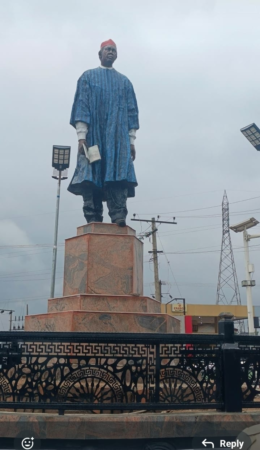
This monument will inevitably become a destination for literary tourists from across the world. Professor Achebe is, in many respects, more celebrated internationally than he is at home. Is this the image we wish to present to those who travel to Ogidi in search of the birthplace of the author of Things Fall Apart?
Without mincing words, the glorified “mannequin” does not reflect the intellectual stature or global reputation of a man whose writings shaped generations and transformed African literature.
Anambra proudly bears the appellation, Light of the Nation, largely because of the extraordinary contributions of men such as Professor Chinua Achebe, Dr Nnamdi Azikiwe, Christopher Okigbo, Chukwuemeka Ike, Dr Alex Ekwueme, Professor Philip Emeagwali, and many other distinguished Ndi Anambra. A monument erected in honour of one of these icons should embody excellence, not mediocrity.
This is not a question of size; it is a question of quality. At first glance, one is tempted to ask in Igbo: “Onye ka Ndi Ogidi nyelu ọlụ a? (To whom did the Ogidi people give this job?). More importantly, what are the person’s professional credentials?
The sculpture falls noticeably below the standard expected of a public monument. Its facial rendering is stiff and devoid of the distinctive features that would make Achebe instantly recognisable or capture the quiet dignity and intellectual depth for which he was renowned.
The anatomy is equally problematic. The figure appears bulky and awkward, with rigid arms, disproportionately broad shoulders and an unnatural lower body that makes it resemble a mannequin rather than a living human being. The traditional attire hangs heavily like a draped sheet instead of flowing naturally over the body to suggest movement and realism.
Equally disappointing is the statue’s complete absence of dynamism. The static pose conveys little of the vitality and commanding presence of a man who profoundly influenced world literature. Even the book in his hand appears crudely attached rather than naturally held. The uneven surface finishing and paintwork seem more like attempts to conceal weak modelling than to enhance artistic expression.
The oversized granite pedestal compounds the problem. Instead of complementing the sculpture, it competes with it for attention. Indeed, one is left with the impression that more resources were invested in the marble and tiled base than in the sculpture itself.
Overall, the monument lacks the refinement, craftsmanship, artistic confidence and commanding presence expected of a landmark public sculpture.
Those who knew Professor Achebe will recall his simplicity. Although he was a titled man, he was never known for flamboyant traditional regalia or elaborate paraphernalia. His global image was that of a modest scholar, usually dressed in his familiar academic or simple attire. One would have expected the sculptor to reflect that universally recognised image rather than clothe him in an ill-fitting gown and oversized trousers.
As if I knew there would be an attempt to put up another monument of an iconic personage, I wrote a two-part article published on May 16 and 18, 2026, in Alpha Times (www.alphatimes.ng and @alphatimes) and a couple of national newspapers, title: “Of Midgets and Monuments – Rescuing Nigeria’s Sculptural Identity.” Because of this gross misrepresentation of our great Ndi Anambra, I will rerun this article starting from tomorrow.
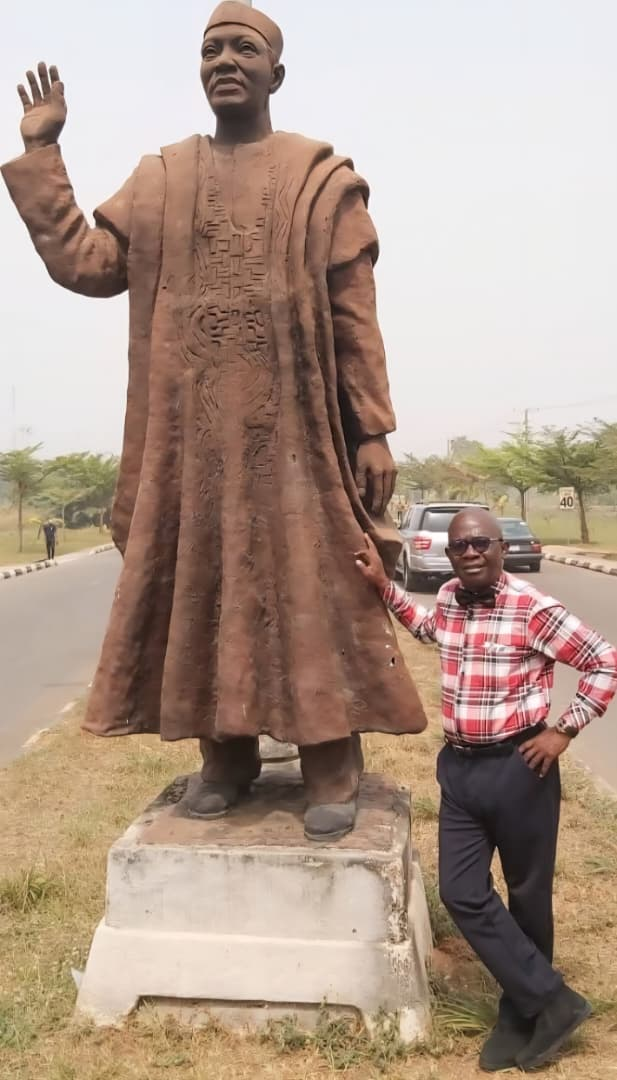
Sadly, Professor Achebe is not alone. Similar artistic injustice has been done to monuments of Dr Nnamdi Azikiwe at the entrance of Nnamdi Azikiwe University, Awka, and at the DMGS Roundabout in Onitsha, as well as the sculpture of Dim Chukwuemeka Odumegwu Ojukwu that welcomes visitors into Anambra State.
The monument at Nnamdi Azikiwe University is perhaps the most baffling because it stands within an academic institution that houses a Department of Fine and Applied Arts, a department that ought to exemplify artistic excellence rather than tolerate mediocrity.
Public monuments are not mere decorations. They are enduring statements of history, identity and collective memory. Long after today’s generation has passed, these sculptures will continue to tell future generations how much we valued those who shaped our civilisation.
For posterity’s sake, some of these so-called monuments should be dismantled, and competent professional sculptors, not roadside artisans, commissioned to produce works worthy of the giants they commemorate.