By Chukwuka Ugokwe || AlphaTimes
The National Vice Chairman of the All Progressives Congress (APC), South-East, Dr. Ijeomah Arodiogbu, has said the administration of President Bola Tinubu is steadily laying the foundation for a more reliable and financially sustainable electricity sector.
He urged Nigerians to assess the reforms through measurable developments rather than political rhetoric.
In a Press Statement issued by his Media Aide, Dr. Arodiogbu said the administration inherited a power sector burdened by legacy debts, inadequate investment, gas-supply constraints, transmission limitations, commercial losses and a large metering deficit, making electricity reliability one of Nigeria’s most difficult structural challenges.
He stated that contrary to the pessimistic narratives often pushed by naysayers, the Tinubu administration has moved Nigeria from an era of permanent systemic gridlock to an era of tangible, record-breaking power generation and distribution.
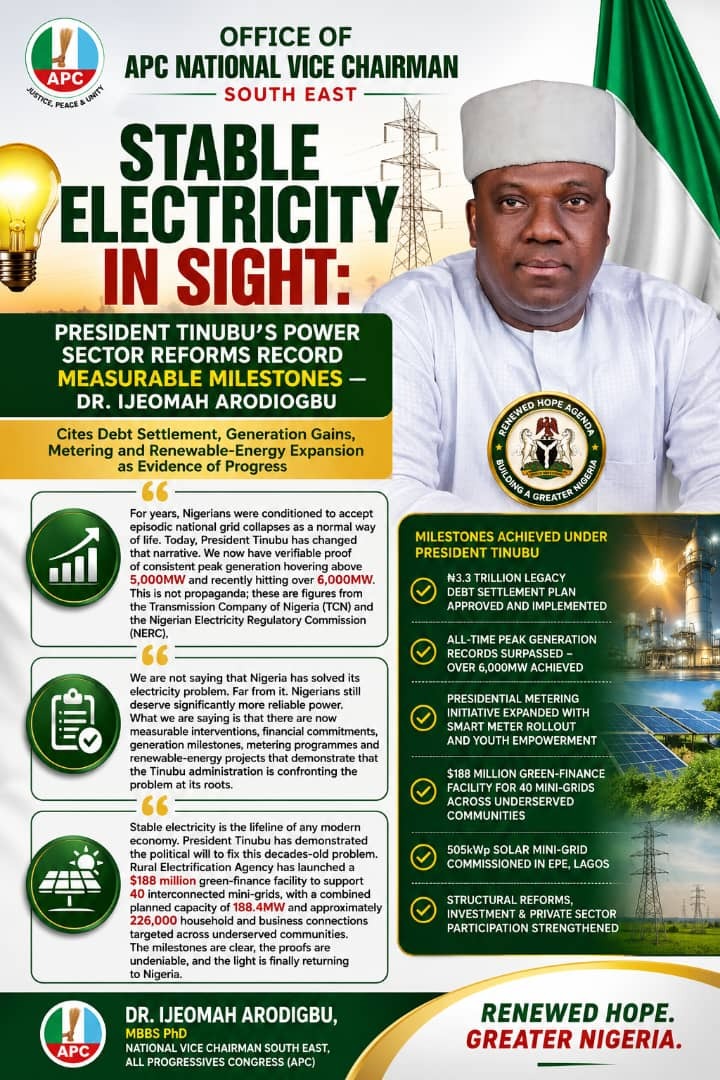
“For years, Nigerians were conditioned to accept episodic national grid collapses as a normal way of life. Today, President Tinubu has changed that narrative. We now have verifiable proof of consistent peak generation hovering above 5,000MW and recently hitting over 6,000MW.
“This is not propaganda; these are figures from the Transmission Company of Nigeria (TCN) and the Nigerian Electricity Regulatory Commission (NERC),” Dr. Arodiogbu stated.
The APC South-East chieftain attributed these successes to the President’s bold decision to sign the Electricity Act 2023, which fundamentally overhauled the sector by decentralizing power generation, transmission, and distribution to allow state governments, private investors, and local communities to participate in the power value chain.
He further cited the recent presidential intervention that liberated the sector from legacy gas debts, which had previously crippled power generation companies (GenCos).
Settling these debts and ensuring a seamless gas-to-power supply chain, the administration effectively unlocked the capacity of dormant power plants.
Dr. Arodiogbu acknowledged that generation figures alone do not constitute stable electricity, stressing that transmission and distribution must improve simultaneously.
“The objective is not simply to generate more megawatts. The real test is how much power reaches homes, businesses, hospitals, schools and industries consistently.
“That is why the reforms across generation, transmission, distribution, metering and market liquidity must be viewed as one interconnected programme.”
“Nigerians are already feeling the impact. We are seeing states like Anambra, Enugu, and others in the South-East taking advantage of the new Electricity Act to build their independent power projects.
“Businesses that were previously crippled by the high cost of diesel are gradually transitioning to grid power. The proof is in the reducing cost of production for our small and medium enterprises,” he added.
While acknowledging that the journey to absolute 24/7 uninterrupted power supply across the federation is still ongoing, Dr. Arodigbu stressed that the foundational milestones achieved by President Tinubu are solid evidence that Nigeria is on the right path.
“We are not saying that Nigeria has solved its electricity problem. Far from it. Nigerians still deserve significantly more reliable power.
“What we are saying is that there are now measurable interventions, financial commitments, generation milestones, metering programmes and renewable-energy projects that demonstrate that the Tinubu administration is confronting the problem at its roots.”
He urged Nigerians, particularly industrialists and entrepreneurs in the South-East, to key into the emerging opportunities in the decentralized power sector, just as he called on the opposition to put aside partisanship and give credit to the administration where it is evidently due.