By Paul Nwosu PhD
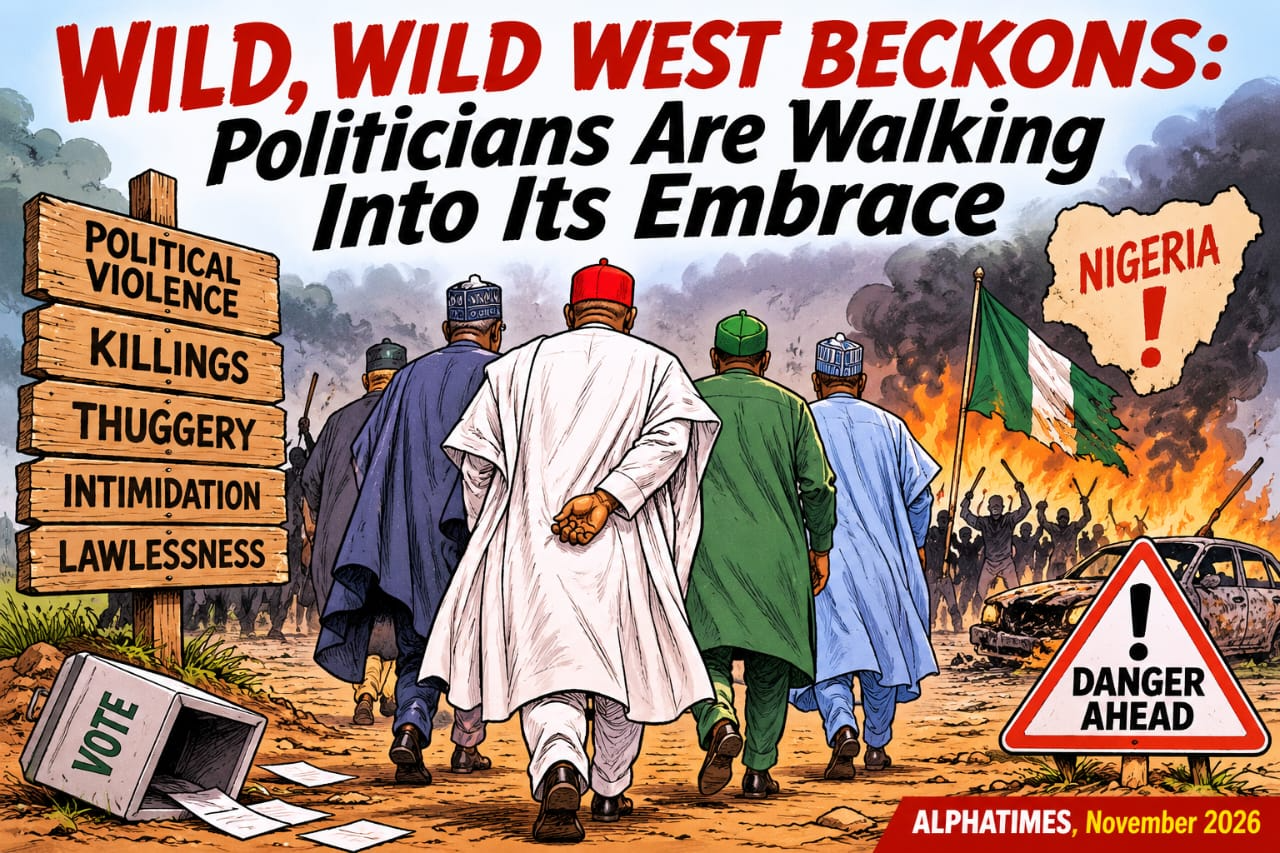
Nigeria is gradually sliding into a dangerous season of political violence, bloodshed and lawlessness. From campaign rallies and political consultations to convoys and public gatherings, the growing pattern of politically motivated attacks across the country is becoming too alarming to ignore.
What should ordinarily be a democratic contest of ideas, competing visions and popular mandates is increasingly degenerating into a bloody struggle in which human lives are becoming expendable.
The statistics are frightening. Between January 1 and October 27, 2026, election-monitoring groups reportedly documented 70 physical election-related attacks and 27 deaths across 19 states and the Federal Capital Territory. The affected states include Bayelsa, Kano, Lagos, Rivers and Sokoto.
In Osun State, the political build-up between May and August 15 reportedly witnessed 34 violent incidents and 18 deaths, according to the Centre for Journalism Innovation and Development (CJID). Police records reportedly put the number of political killings at 30. Areas particularly affected included Ilesa, Oriade, Ilobu and Osogbo.
Global Rights also documented 15 serious election-related incidents between late August and September, comprising four killings, four attacks on political leaders, three intimidation cases, two abductions and two incidents of political office vandalism.
The situation has since assumed even more disturbing dimensions.
On October 10, violence reportedly erupted during the Nigeria Democratic Congress (NDC) campaign launch in Enugu, leaving Ifeanyi Nwolie dead from gunshot injuries.
On October 22, gunmen attacked the campaign convoy of Ebonyi political candidate Rollins Offia-Nwali, killed one person, injured three others and set the candidate’s vehicle ablaze. The candidate reportedly escaped.
In Malumfashi, Katsina State, vehicles conveying APC supporters to a political meeting were attacked, leaving a female motorist injured. In Calabar, Cross River State, PDP political consultations were disrupted by gunmen at two separate locations. Campaign convoys of the African Democratic Congress (ADC) were also reportedly attacked in separate incidents in Igueben, Edo State, and Kogi State.
The November 7 attack on the NDC One Million-Man March for its presidential candidate, Peter Obi, in Asaba, Delta State, was particularly gruesome. Suspected political thugs armed with sticks, knives and machetes reportedly attacked participants along Nnebisi Road, vandalising more than 30 vehicles. The Delta State Police confirmed one death and five injuries.
Even more horrifying was the November 23 bloodbath at Uduere, Ughelli North Local Government Area of Delta State. Gunmen opened fire during a campaign tour for former Deputy Senate President Ovie Omo-Agege, the NDC candidate for Delta Central Senatorial District. The Nigeria Police reportedly confirmed six deaths and several injuries, although the candidate’s campaign initially reported four aides killed and four others critically injured.
Interestingly, less than 24 hours after the attack a Federal High Court in Warri nullified Omo-Agege’s nomination as the NDC senatorial candidate, adding another disturbing dimension to the already volatile political atmosphere.
Meanwhile, the reported stoning of President Bola Tinubu’s convoy during a visit to a mosque is another troubling indication of how dangerously intolerant and volatile our political environment is becoming.
These incidents, taken together, should worry every patriotic Nigerian, irrespective of political affiliation.
It appears we are dangerously approaching a familiar historical precipice.
The political violence that engulfed Nigeria’s Western Region in the mid-1960s, popularly remembered as Wild, Wild West, remains one of the darkest chapters in our political history. Electoral manipulation, political intolerance, thuggery, arson and killings progressively weakened democratic institutions and contributed to the national crisis that culminated in the January 1966 coup and the chain of events that eventually led to the Nigerian Civil War.
We must not allow history to repeat itself. Indeed, if the present situation is not urgently arrested, the Wild, Wild West experience could become a child’s play compared with what may unfold.
Political leaders must understand that they cannot light fires in the streets and expect to remain insulated from the consequences. Those who recruit, finance, encourage or shield political thugs must be held accountable. A political supporter is not a soldier, and an opponent is not an enemy of the state. Democracy does not confer a licence to kill, maim, intimidate or destroy.
The Nigeria Police Force also has an enormous constitutional responsibility. It must rise above partisan considerations and discharge its duties firmly, professionally and dispassionately, without minding whose ox is gored. The law must apply equally to the ruling party and opposition, powerful politicians and ordinary supporters alike.
Those who sponsor violence must be identified, investigated and prosecuted. Security agencies must not wait until bodies are counted before responding to obvious warning signs. Political gatherings, campaign convoys and vulnerable communities must receive adequate protection.
Former President Goodluck Jonathan was absolutely right when he reminded Nigerians that no political ambition is worth the life of any Nigerian. That timeless admonition should be the guiding creed for every politician, party leader and political supporter.
There is also an enduring Igbo proverb that says it is better to tether the black goat early before darkness falls and makes it impossible to find. In other words, prevention is wiser than belated lamentation.
Our political leaders must rein in their supporters. Security agencies must act decisively. Political parties must condemn violence, not rationalise it when it serves their interests. And the judiciary must continue to dispense justice without fear or favour.
Nigeria cannot afford another descent into political anarchy. The price of complacency could be catastrophic.
A stitch in time saves nine. Let us act before the black goat disappears into the darkness.