By Paul Nwosu PhD || AlphaTimes
One of the clearest distinctions between a civilised society and Thomas Hobbes’ State of Nature is the presence, and respect, of law and order. Civilisation depends not merely on rules, but on the discipline with which people obey them. Only then can the weak coexist with the strong, the poor with the rich, and order prevail over chaos.
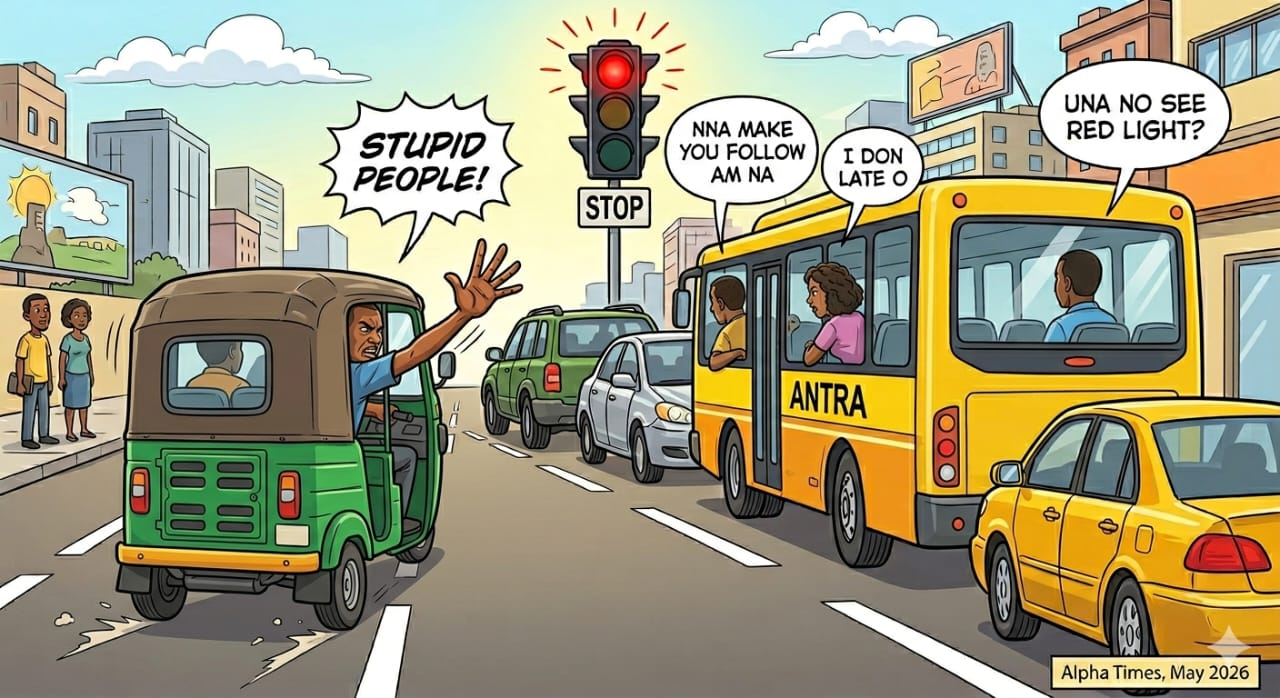
When governments invest public funds in traffic lights at busy intersections, the intention is simple – safety and efficiency. These systems are designed to regulate movement, prevent collisions and reduce the burden on human traffic controllers. But their effectiveness collapses the moment compliance becomes selective, when some drivers obey and others do not. That is where disorder begins.
A red light is not ornamental; it is a command. When it appears, it signals one stream of traffic to stop while another proceeds. Disregarding it is not merely a personal gamble, it is an invitation to collision. The result is predictable – accidents, gridlock, damaged vehicles, injuries, and sometimes death. Ironically, such outcomes are often blamed on fate or divine will – “uche Chukwu” or “akalaka”. Yet, more often than not, they are the direct consequences of human choices.
The problem has become widespread. While commercial drivers, particularly tricycle operators and bus drivers, are frequent offenders, they are far from alone. Government vehicles, refuse trucks and even contractors’ fleets routinely violate traffic signals. More troubling is the conduct of security personnel. Police and military drivers, even when not on emergency duty, often ignore traffic lights with impunity. Their actions set a dangerous precedent. When enforcers of the law disregard it, they erode the moral authority to demand compliance from others.
The same culture of disregard fuels the equally hazardous practice of driving against traffic (“one way”), turning roads into unpredictable danger zones.
This growing indiscipline calls for urgent and decisive action. Enforcement must be consistent and impartial, cutting across all categories of drivers. Traffic agencies should collaborate closely with the police and civil defence corps to demonstrate seriousness. Public education campaigns, especially in motor parks and through the media, must reinforce the message – traffic rules are non-negotiable.
Equally important, security agencies must rein in their personnel. Emergency situations may justify exceptions; routine movements do not. When those entrusted with authority model compliance, they strengthen the legitimacy of enforcement.
Order on the roads is not a luxury, it is a necessity. And it begins with a simple principle: red means stop. Not sometimes. Not for some people. But always, and for everyone.