By Charles Nwoke
A youth from Ebonyi State, known on social media as “Nose of the Gods,” has launched a grassroots campaign urging young people to reconsider early marriage and rapid childbearing. The initiative has attracted attention across the state and on social media.
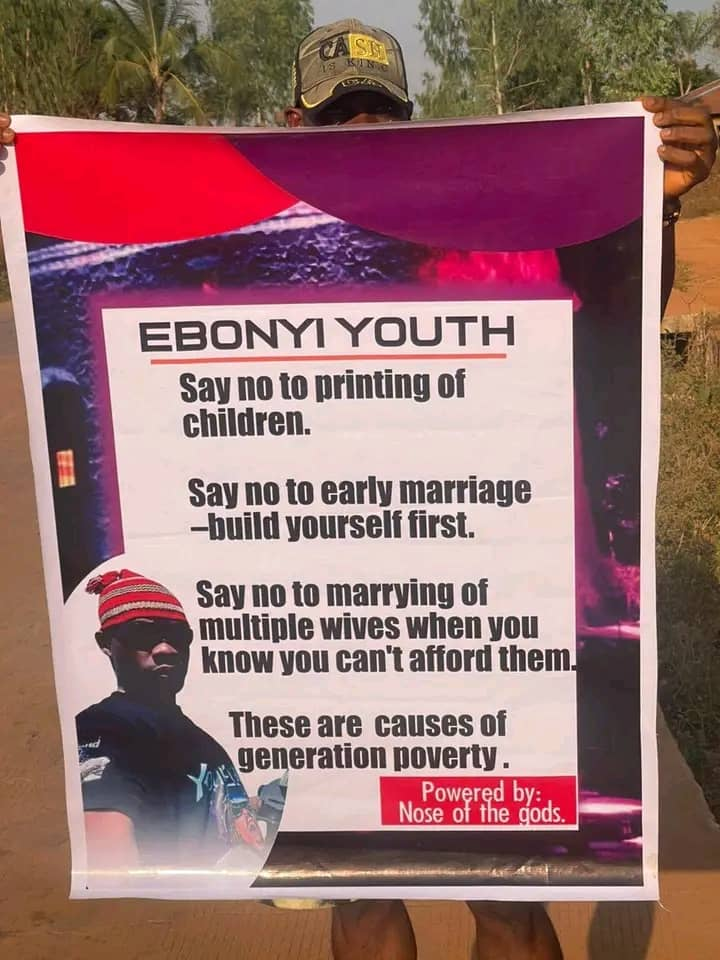
In recent weeks, banners bearing bold messages have appeared at major junctions in parts of Ebonyi State. The messages question long-standing social norms around marriage and family size among young adults.
In a video shared online, the campaigner explained the motivation behind the outreach. He said the effort seeks to change attitudes that contribute to slow development in the state. He described the campaign as his personal way of supporting the administration of Governor Francis Nwifuru in advancing Ebonyi State’s development goals.
The activist stated that Ebonyi State frequently faces negative judgment from neighbouring states, including Anambra, due to its visible underdevelopment. He linked this perception partly to choices he observes among young people who prioritise marriage and childbearing in their early twenties over education, skills acquisition, and economic investment.
He argued that such priorities limit personal and collective progress. “If you give a 20-year-old Ebonyi boy one million naira, he will think first of getting married instead of investing in a business or skill,” he said, urging young men and women to rethink their decisions for the sake of the state’s future.
Early marriage remains a concern in Ebonyi State, where about 13 percent of women aged 20 to 49 were married before the age of 18. Studies associate early marriage with lower educational attainment and reduced economic opportunities, which can reinforce cycles of poverty and underdevelopment.
The campaign carries the message, “NO TO EARLY MARRIAGE, NO TO PRINTING OF CHILDREN.” While many supporters have shared and praised the initiative, others have expressed discomfort and disagreement, arguing that the message is controversial.
Though driven by one individual, the campaign reflects broader youth-led conversations on development, social norms, and economic empowerment in southeastern Nigeria. It highlights the growing efforts of young people to influence public opinion and advocate for long-term change in their communities.