Uzor Maxim Uzoatu
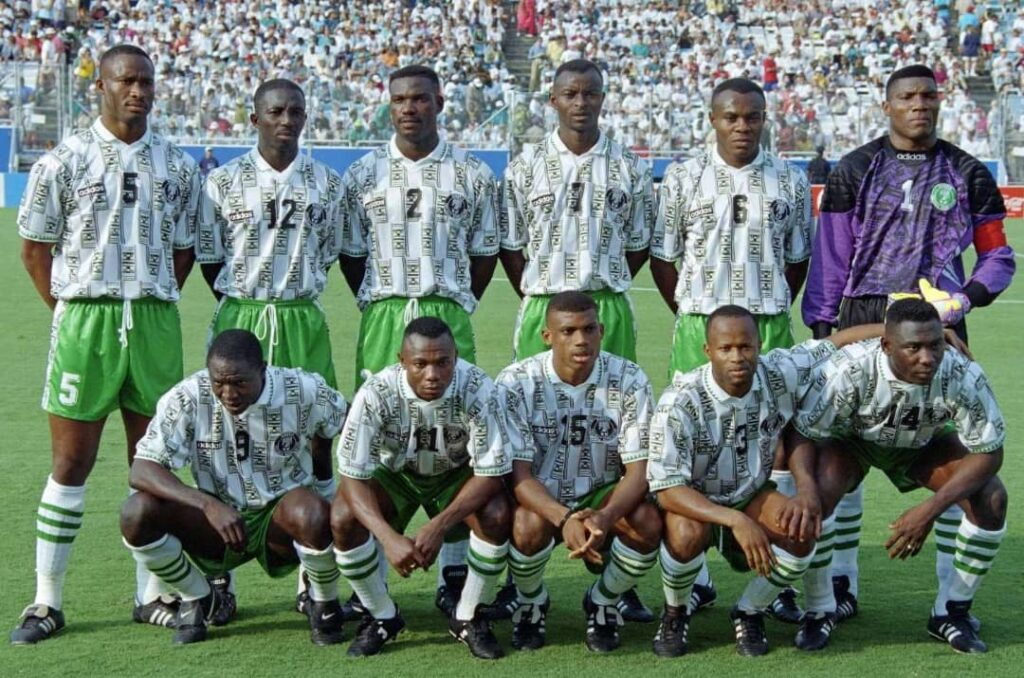
The Super Eagles of Nigeria made an unforgettable debut in the FIFA World Cup with characteristic swagger. In a sweeping 22nd minute move, fleet-footed Finidi George sped down the right wing and put a low cross that danger-man Rashidi Yekini tapped into the Bulgarian net for Nigeria’s first-ever goal in World Cup history. Yekini ran into the goal, shook the net maniacally with upraised hands, uttering words nobody has thus far been able to decode. Yekini’s celebration of that epochal goal was listed amongst the most iconic celebrations of goals in the history of the World Cup. This happened in 1994 AD.
It bears the hallmark of history that Nigeria made her first appearance in the FIFA World Cup in the year that the fiesta was staged for the very first time in the United States of America. The Super Eagles of Nigeria made the grand entry into America as the champions of Africa, having won the coveted African Cup of Nations in Tunisia in February 1994. The team came to the World Cup with a sparkling reputation, for in April 1994, the Super Eagles got ranked 5th in the FIFA World Rankings, the highest ranking ever achieved by an African national football team.
The United States hosted with characteristic American aplomb the 1994 FIFA World Cup which marked the 15th edition of the competition. From June 17 to July 17 1994, the FIFA World Cup took pride of place in nine cities across the United States, a nation where soccer had not hitherto been the most popular sport, but which was chosen as the host by FIFA on July 4, 1988. Distinguished soccer-loving Americans such as Henry Kissinger had lobbied endlessly over the years for the United States to be granted the hosting rights to the esteemed FIFA World Cup. The US lobby turned successful with the granting of the hosting rights in 1988, and the Americans did not disappoint at all in hosting a hugely successful competition in 1994.
The “Adidas Questra” was the official match ball for the competition. Before the hosting of the World Cup by the US, no other FIFA World Cup had exceeded 53,000 spectators in average attendance, yet the Americans produced an eye-popping average attendance of 69,000 spectators. In the end, the total attendance of nearly 3.6 million for the final tournament broke the record for the highest spectatorship in World Cup history. The FIFA World Cup had been expanded from 24 to 32 teams in the 1998 World Cup staged in France, thus extending the number of matches played in the tournament from 52 to 64.
Millions of Nigerians who could not travel to the US to bear witness to the august World Cup watched on live television the opening ceremony which was held on June 17at Soldier Field Stadium in Chicago. The then United States President Bill Clinton partook of the opening ceremonies alongside such eminences as the then Chancellor of Germany, Helmut Kohl, and the President of Bolivia, Gonzalo Sánchez de Lozada. Television goddess Oprah Winfrey served as the MC of the ceremony, and she added the hilarious drama of falling off the dais whilst introducing Diana Ross to give a musical performance. The music of the evergreen Diana Ross reverberated through the stands and across the globe via television. The arrangement, in proper American wonder, was that Diana Ross would end her performance by kicking the Adidas Questra ball into the goal from the penalty spot, “with the goal then splitting in two as part of a pre-orchestrated stunt.”
But soccer was hardly an American sport, and the moment would be frozen in time: Diana Ross completely mishit the ball, sending it rolling wide to the left of the empty goal. The organizers of the stunt were smart enough to collapse the goalposts anyway to tally with the original plans of Diana Ross’s penalty shot shattering the net! The other musical performances at the opening ceremonies came from Daryl Hall and Jon Secada.
And thus the stage was then set for the Super Eagles of Nigeria to make a historic debut at the FIFA World Cup in America on June 21, 1994 at the Cotton Bowl Stadium, Chicago in an epic match against Bulgaria against the Hristo Stoichkov-inspired Bulgaria. The Super Eagles filed out with Peter Rufai in goal. The back-four quartet was made up of stand-in captain Augustine Eguavoen, Uche Okechukwu, Chidi Nwanu and Ben Iroha. In the midfield, Sunday Oliseh was the middle pivot between Finidi George on the right and Emmanuel Amunike on the left. Coach Clemens Westerhof slotted Samson Siasia in the creative midfield role that was erstwhile reserved for Augustine Jay-Jay Okocha. The coach’s argument was that the urgency of the first match did not need the “showboating” of Okocha. The deadly pair of Rashidi Yekini and Daniel Amokachi formed the strike-force of the team on parade.
The match was a cagey affair, and nerves showed aplenty amongst the Nigerian debutants and the Bulgarians who had never won a World Cup match. The game somewhat opened up when Bulgarian skipper hammered a free-kick into the Nigerian net, but his jubilation was cut short because the referee had spotted an infringement. Then in the sweeping move highlighted at the beginning, Finidi George fed Rashidi Yekini to score Nigeria’s historic World Cup goal. Daniel Amokachi scored Nigeria’s second goal just before halftime on the 44th minute. Emmanuel Amunike put the match to bed with the last goal which he scored after 56 minutes, thus sealing a 3-0 victory for the Super Eagles.
Remarkably, Bulgaria that Nigeria trounced 3-0 eventually got to the semi-finals while Italy that edged out Nigeria 2-1 in the second round lost the World Cup final match to Brazil on penalties!
We could have won the World Cup on our debut!