By Kanayonmuo Azaka || AlphaTimes
The Joint Committee on Constitution Review of the National Assembly has approved the creation of six new states across Nigeria’s six geopolitical zones as part of its ongoing constitutional amendment exercise.
If ratified, the number of states in the federation will rise from 36 to 42 with the North-West having eight states, while the North-East, North-Central, South-West, and South-South will each have seven states, and the South-East will increase from five to six.
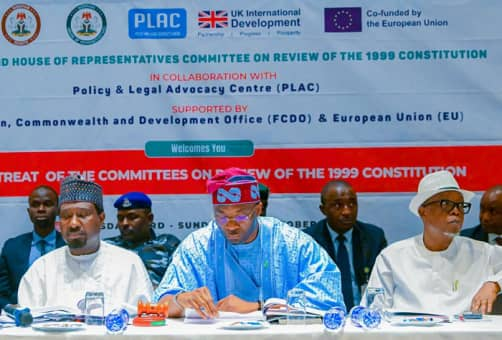
The decision was reached at a two-day retreat held in Lagos from Friday to Saturday. The committee also resolved to set up a sub-committee, chaired by the Chief Whip of the Senate, Tahir Monguno (APC, Borno North), to determine the specific areas from which the six new states will be carved out.
During the session, members reviewed 55 separate proposals for new states, two boundary adjustment requests, and 278 demands for additional local government areas from various groups nationwide.
It was earlier reported in the media that the committee had agreed to create an additional state for the South-East, which currently has only five states, Abia, Anambra, Ebonyi, Enugu, and Imo, to achieve parity with other zones.
Deputy Senate President Barau Jibrin and Deputy Speaker Ben Kalu, who co-chair the joint committee, are expected to present the resolutions when both chambers reconvene for plenary. The proposals will then be debated and voted upon at the Committee of the Whole before being transmitted to the President for assent, following due constitutional process.
Section 8 of Nigeria’s 1999 Constitution outlines the procedure for creating new states.
It requires a formal request signed by at least two-thirds of the elected representatives — Senators, members of the House of Representatives, and members of the State House of Assembly — from the affected area.
This request must then be approved through a referendum by at least two-thirds of the people in that area. Subsequently, a simple majority of all state legislatures, representing at least 19 states, must endorse the proposal.
Finally, the measure must be passed by a two-thirds majority in both chambers of the National Assembly before being presented to the President for assent.
While the joint committee has pledged to complete the constitution review process and transmit its recommendations to state Houses of Assembly before the end of the year, the proposal faces several challenges.
Since 1999, the Nigerian Constitution has been amended five times, but many reform proposals, including past efforts at state creation, have been rejected at the state level. Public criticism has also trailed the high cost and slow pace of the review process.
The approval of six new states is expected to ignite fresh political lobbying, as regional leaders and power blocs push for the location of the new entities within their territories.
Already, competing proposals are before the National Assembly. In the South-West, bills seeking the creation of Ibadan and Ijebu States are under consideration. In the South-South, Senator Ned Nwoko (APC, Delta North) is sponsoring a bill for Anioma State, which he argues should be recognised as part of the South-East, given its predominantly Igbo population.
As lawmakers prepare for plenary debate, the coming weeks will determine whether Nigeria’s long-standing agitations for state creation will finally translate into constitutional reality.