By Paul Nwosu, PhD
Politicians often spend billions searching for the perfect campaign message. Sometimes, however, the most potent political statement is made without a campaign speech, without a rally and without a single party slogan.
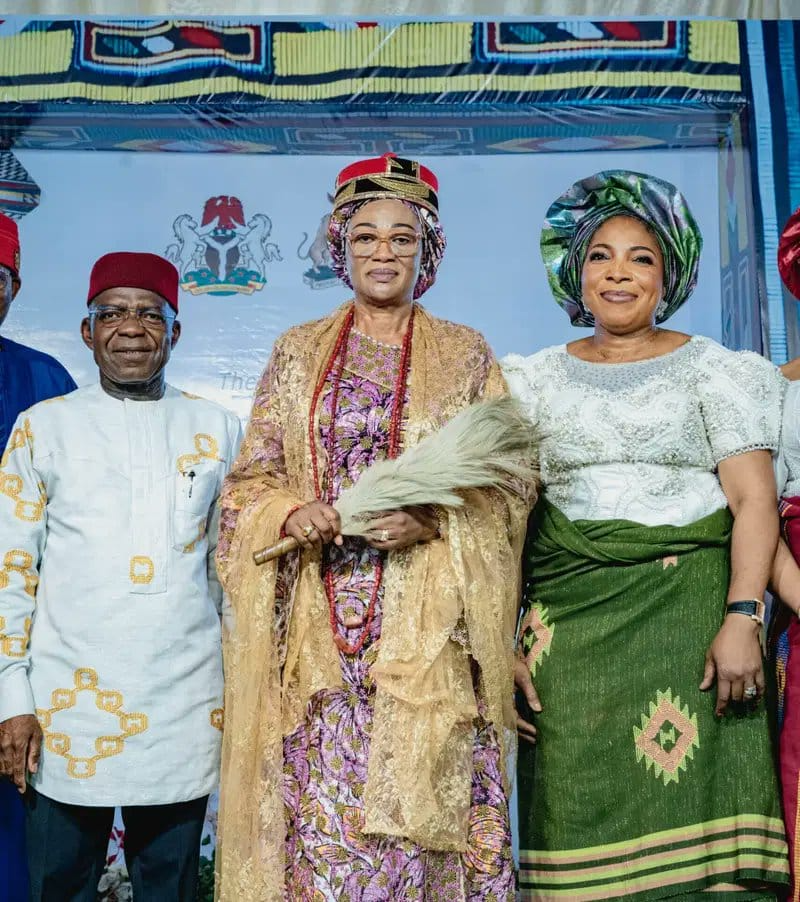
That may well have happened when First Lady, Senator Oluremi Tinubu, visited the Akwete Weaving Cooperative Village in Abia State. She announced a ₦2 billion intervention to revive the famous indigenous textile industry and then added, almost casually, that she would wear an Akwete buba and wrapper if her husband, President Bola Ahmed Tinubu, wins a second term in 2027.
That seemingly harmless comment deserves closer examination.
For years, the APC’s political salesmen in the South-East have adopted a remarkably unimaginative strategy. They lecture the Igbo about gratitude. They remind them of federal roads. They point to appointments. They practically insist that infrastructure should automatically translate into votes. It is a curious brand of politics that mistakes development which every government owes every citizen, for a favour that demands electoral repayment.
Some have become so obsessed with proving their loyalty to the President that they now sound less like political leaders and more like court jesters. Their message to Ndigbo is often less persuasion than blackmail: Tinubu has done this for you; therefore you must vote for him. Politics rarely works that way.
Mrs. Tinubu, perhaps without intending to, demonstrated a far superior approach. She did not threaten. She did not preach. She did not bargain. She simply celebrated an Igbo cultural treasure. She invested in its preservation. She acknowledged the women whose hands have kept the centuries-old Akwete weaving tradition alive. In doing so, she spoke the language of respect rather than entitlement.
Equally significant was the venue. She chose Abia State, governed by Dr. Alex Otti of the Labour Party, one governor in the South-East who has stubbornly refused to join the fashionable migration to the APC. While others scramble to prove proximity to presidential power, Otti has maintained that his legitimacy derives from the people who elected him, not from changing political jerseys whenever Abuja beckons.
Whether one agrees with his politics or not, consistency commands respect. It also made Mrs. Tinubu’s visit politically symbolic. If the APC seeks acceptance in the South-East, it cannot afford to rely solely on defectors whose greatest political skill appears to be switching parties with the changing political weather.
There was, however, one line in the First Lady’s remarks that betrayed a subtle contradiction. She said she would wear Akwete if President Tinubu wins re-election.
Why wait after committing ₦2 billion to revive the industry? Why postpone becoming its most influential ambassador? If Akwete deserves national celebration, and it certainly does, then it deserves to be worn now, not after an election victory.
That conditional phrase sounded like what linguists call “lapsus linguae”, a Freudian Slip that inadvertently reveals an underlying assumption. The First Lady probably meant no more than to express optimism about her husband’s political future. Yet the statement unintentionally reduced Akwete from a cultural symbol worthy of immediate embrace to a post-election wardrobe choice. That would be unfortunate.
If Mrs. Tinubu truly wants to help her husband make inroads into the South-East, she should begin wearing Akwete today. Better still, it should occasionally be complimented with the regal “Isi Agu”. Let Nigerians see her proudly dressed in the products of Igbo creativity at state functions, diplomatic receptions and national celebrations.
Such images would speak louder than a thousand speeches delivered by politicians perpetually advertising their closeness to the Villa.
The South-East has never lacked intelligence. It has never lacked the capacity to distinguish genuine respect from political performance. The region responds better to sincerity than to sycophancy, better to inclusion than to intimidation.
Roads matter. Bridges matter. Economic reforms matter. But politics is ultimately about relationships. People are persuaded not merely by asphalt and concrete but by gestures that acknowledge their identity and dignity.
Ironically, the most effective APC campaign in the South-East this week did not come from party chieftains, ministerial surrogates or governors competing for presidential applause. It came from a First Lady who celebrated an ancient fabric and the women who weave it.
Now, she should complete the message. We call on Mrs Remi Tinubu to wear Akwete before 2027. Not because President Tinubu has already won, but because respect should never be conditional on electoral victory. If that happens, she may discover that soft cultural empathy and diplomacy succeeds where loud political evangelism has repeatedly failed.