By AlphaTimes News Desk
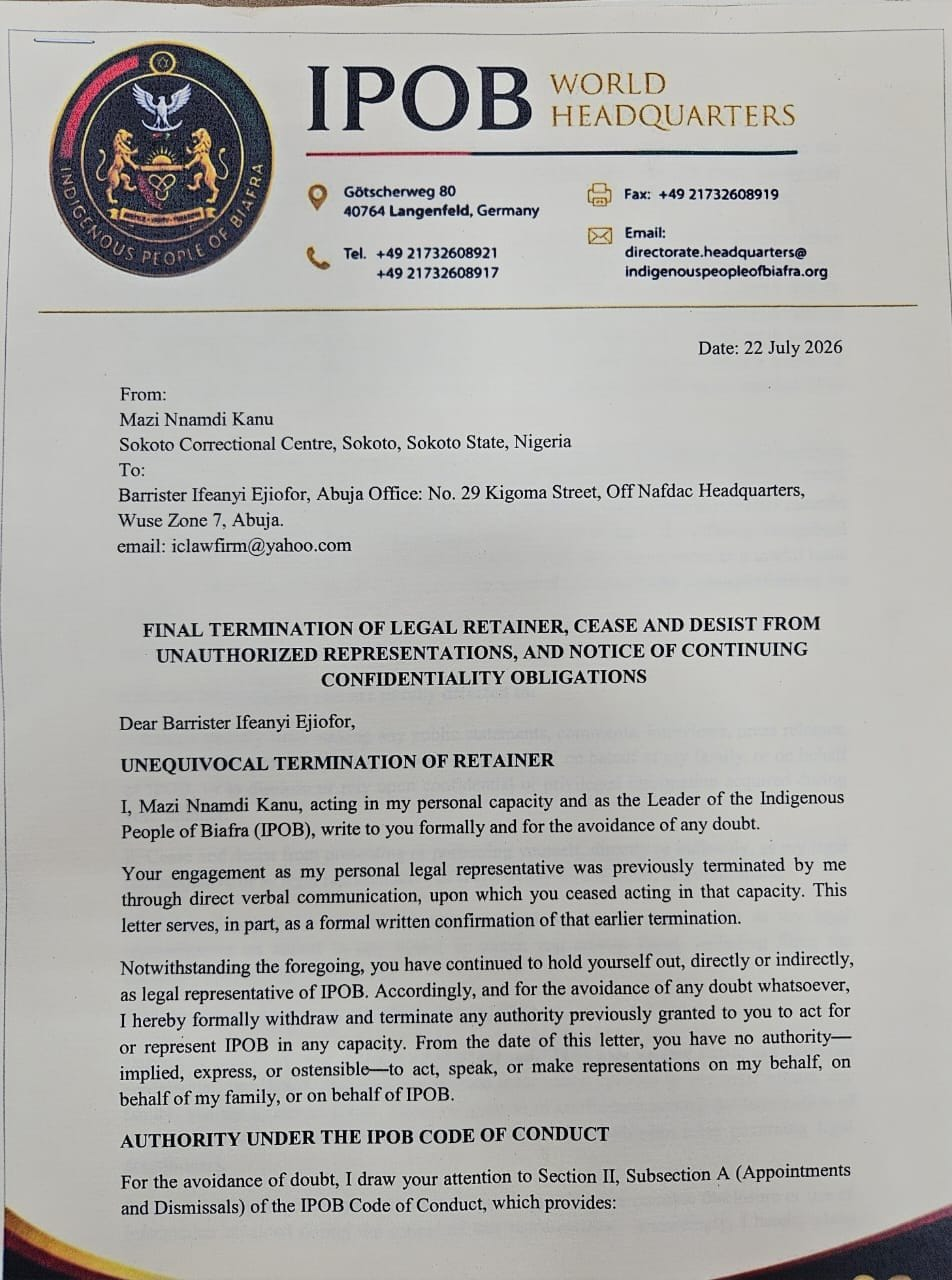
The detained leader of the Indigenous People of Biafra (IPOB), Nnamdi Kanu, has formally terminated the services of his longtime lawyer, Barrister Ifeanyi Ejiofor, accusing him of continuing to act on behalf of both himself and the separatist organisation without authorisation.
In a letter dated July 22, 2026, and signed by Kanu from the Sokoto Correctional Centre, the IPOB leader confirmed that Ejiofor’s appointment as his personal legal representative had earlier been revoked verbally, saying the latest correspondence was intended to formalise that decision.
Kanu stated that all authority previously granted to Ejiofor to represent him, his family, or IPOB had been withdrawn with immediate effect.
He alleged that despite the earlier termination, Ejiofor continued to present himself publicly as legal counsel for IPOB, prompting what he described as a final and unequivocal withdrawal of every mandate previously given to the lawyer.
“From the date of this letter, you have no authority, implied, express, or ostensible, to act, speak, or make representations on my behalf, on behalf of my family, or on behalf of IPOB,” Kanu stated.
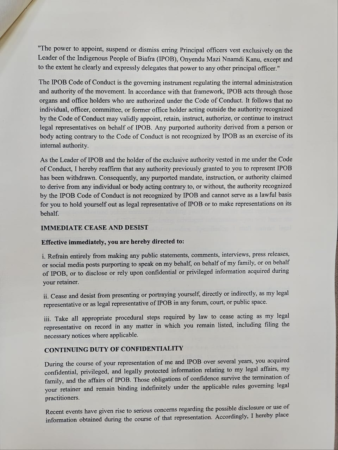
The IPOB leader anchored his decision on the organisation’s Code of Conduct, insisting that only the leader of IPOB has the authority to appoint or remove principal officers or approve legal representation unless such powers are expressly delegated.
He further declared that any authority purportedly granted to Ejiofor by any other individual or body outside the provisions of the IPOB Code of Conduct would not be recognised by the organisation.
Kanu directed Ejiofor to immediately cease issuing public statements, granting interviews, releasing press statements, or making social media posts concerning him, his family, or IPOB.
He also instructed the lawyer to stop presenting himself as Kanu’s legal representative before any court, public institution, or official forum, and to take appropriate legal steps to withdraw from all pending matters where he remains listed as counsel.
The IPOB leader reminded Ejiofor that the legal obligation of confidentiality survives the termination of a lawyer-client relationship, warning against the disclosure or misuse of confidential information obtained during years of legal representation.
According to Kanu, recent developments had raised “serious concerns” over the possible disclosure or misuse of privileged information, although the letter did not identify any specific incident.
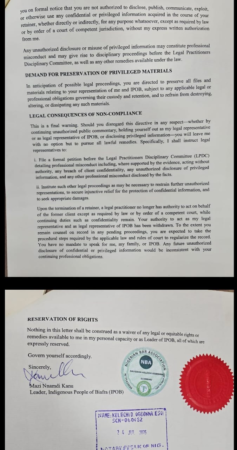
He warned that any unauthorised disclosure of confidential information could amount to professional misconduct and expose Ejiofor to disciplinary proceedings before the Legal Practitioners Disciplinary Committee (LPDC), in addition to other legal consequences.
Kanu also directed the lawyer to preserve all files, records and materials relating to his legal representation of both himself and IPOB in anticipation of possible legal proceedings.
As what he described as a final warning, Kanu said he would initiate disciplinary proceedings before the LPDC and pursue other legal remedies, including injunctions and claims for damages, should Ejiofor continue to hold himself out as his legal representative or disclose confidential information.
He concluded by reserving all legal and equitable rights available to him both in his personal capacity and as leader of IPOB, while directing Ejiofor to “govern yourself accordingly.”