By Charles Nwoke || AlphaTimes
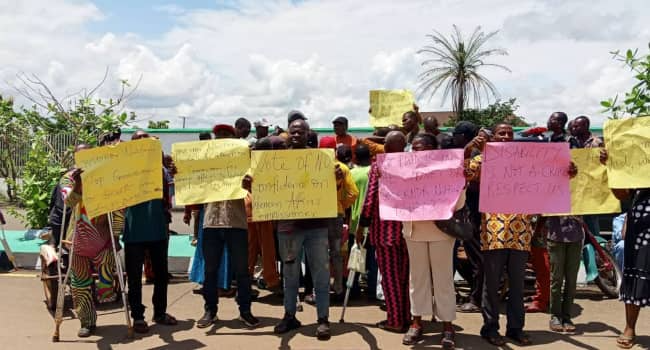
Members of the Joint National Association of Persons With Disabilities (JONAPWD), Ebonyi State Chapter, on Thursday staged a peaceful protest in Abakaliki over alleged neglect by the Ebonyi State Government, demanding improved welfare, monthly financial support, and the immediate assent to the Disability Bill recently passed by the Ebonyi State House of Assembly.
The protesters also opposed an alleged directive ordering the association to vacate its secretariat, which it has occupied for more than 10 years, with no alternative facility.
Carrying placards with different inscriptions, the demonstrators appealed to Ebonyi State Governor Francis Nwifuru to intervene. They stressed that disability is not a crime and called for greater inclusion of persons with disabilities in governance, political appointments, and state empowerment programmes.
The protesters urged the state government to provide monthly financial subventions to the association, strengthen welfare support for members, and ensure the prompt signing of the Disability Bill into law.
Addressing journalists during the protest, the Chairman of the Joint National Association of Persons With Disabilities in Ebonyi State, Comrade Friday Nwovu, said members had continued to face marginalisation despite several appeals to government authorities.
He expressed concern over the alleged quit notice issued by the Commissioner for Health, Dr Moses Ekuma, and the Commissioner for Women Affairs and Social Development, Barrister Felicia Nwamkpuma.
According to him, the association received the directive to vacate its secretariat without prior consultation or dialogue, a development he described as unfair to persons with disabilities.
Nwovu appealed to Governor Nwifuru to intervene by approving monthly financial subventions for the association, expanding welfare programmes for members, signing the Disability Bill into law, and appointing qualified persons with disabilities into strategic public offices.
He said greater participation of persons with disabilities in government would promote inclusion and demonstrate the administration’s commitment to equal opportunities for all citizens.
Despite the concerns raised during the protest, Nwovu reaffirmed the association’s support for the administration of Governor Nwifuru and expressed confidence in the government’s ability to address the issues before the 2027 general elections.
Responding to the protesters on behalf of the state government, the Chief of Staff to the Governor, Professor Emmanuel Echiegu, assured the association that Governor Nwifuru had already approved the Disability Bill for final assent.
He said the remaining administrative process would be completed soon, paving the way for the bill to become law.
Echiegu also highlighted the government’s efforts to improve the welfare of persons with disabilities across the state.
According to him, more than 300 persons with disabilities have already been enrolled in the Ebonyi State Health Insurance Agency (EBSHIA), enabling them to access free healthcare services under the state health insurance scheme.
He assured the protesters that the state government remained committed to addressing their concerns regarding welfare, accommodation, and inclusion.
The Chief of Staff further disclosed that Governor Nwifuru had directed that an immediate harmonisation meeting be held between leaders of the Joint National Association of Persons With Disabilities and the Commissioners for Health and Women Affairs and Social Development.
He said the meeting would provide an opportunity for all parties to resolve the issues surrounding the association’s secretariat and other concerns through dialogue.
The peaceful protest ended after the government assured the demonstrators that discussions would begin immediately to find lasting solutions to their demands.
The protest has drawn attention to renewed calls for the protection of the rights of persons with disabilities in Ebonyi State, with stakeholders urging the swift implementation of policies that promote inclusion, equal opportunities, accessible healthcare, and improved welfare for people living with disabilities.