By Charles Nwoke
The Ebonyi State Ministry of Justice has secured the release of 328 inmates under its prison decongestion programme, reinforcing the government’s commitment to expand access to justice and strengthen justice delivery across the state.
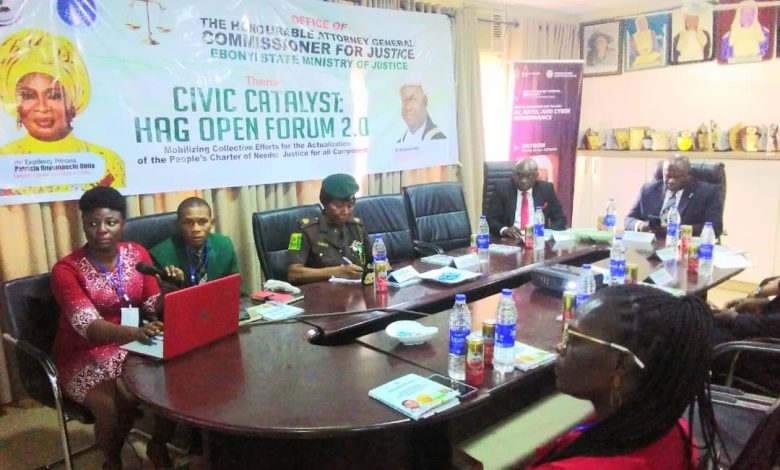
Attorney-General and Commissioner for Justice, Dr Ben Uruchi Odo, announced the figure on Monday in Abakaliki during the maiden Public Accountability Forum, tagged AG Open Forum 2.0 (Empowering Citizens, Advancing Justice). The forum was organised through the Ministry’s civil society collaboration desk.
Odo stated that the releases were made through the prerogative of mercy and other components of the Ministry’s strategic legal framework, the People’s Charter of Justice. He stated that the programme aims to ease congestion in correctional centres while promoting fair and timely justice.
The Attorney-General outlined several reforms his administration has implemented. He said the Ministry has upgraded its infrastructure and strengthened the capacity of legal officers. He also highlighted the expansion of victim-offender mediation, which has advanced restorative justice by supporting reconciliation, restoration, reintegration and reinstitution.
Odo noted that the Ebonyi Multi-door Courthouse, the Citizens’ Mediation Centre and the Office of the Public Defender now play central roles in mediation, arbitration and conciliation. More than 20 lawyers have been trained as chartered arbitrators to reinforce these services. The Citizens’ Mediation Centre has reduced avoidable litigation, while the Public Defender’s Office offers pro bono legal services to indigent residents, complementing the Legal Aid Council.
The Attorney-General further disclosed progress toward digitising the justice system. He said the Ministry has procured and installed Speech-to-Text machines under a grant and supported the judiciary in establishing six virtual courts—one for the Chief Magistrate’s Court and five for the High Court—alongside four virtual hearing centres in the Correctional Centre.
Other innovations include the decentralisation of the Ministry across the three senatorial zones, the creation of an ICT-driven Law Reporting Department and the introduction of the Ebonyi State Ministry of Justice Law Journal, scheduled for launch soon.
Odo said the Ministry has also assisted the state government in drafting several bills, 13 of which have been signed into law. These include the law that increased the monetary jurisdiction of the Chief Magistrate’s Court from N500,000 to N5 million. He added that the state has partnered with LexisNexis to codify Ebonyi laws, last updated in 2009.
He identified funding constraints, bureaucratic delays, language barriers and the need to improve judicial welfare as key challenges. He said the Ministry will pursue full implementation of the Administration of Criminal Justice reforms in 2026, expand Citizens’ Mediation Centres to all 13 local government areas and collaborate with the Ministry of Women Affairs to strengthen juvenile justice.
Earlier, the initiator of the forum and Technical Assistant to the Attorney-General, Oluchi Esther Nwite, said the meeting aimed to promote citizens’ engagement, enhance accountability and gather input for the People’s Charter of Justice under the Charter of Needs agenda of Governor Francis Nwifuru’s administration.
Stakeholders at the event included the Commissioner for Information and State Orientation, Chief Ikeuwa Omebe; Commissioner for Solid Minerals Development, Engr. Chidi Onyia, representatives of the Commissioner of Police, and the Correctional Service. They commended the Attorney-General for the initiative and pledged continued collaboration to strengthen justice delivery in the state.
The event featured question-and-answer sessions with participants attending both physically and through the Ministry’s social media platforms.