By Charles Nwoke || AlphaTimes
The Vice Chancellor of David Umahi Federal University of Health Sciences (DUFUHS), Uburu, Ebonyi State, Professor Jesse Uneke, has urged members of the Polymer Institute of Nigeria (PIN) to focus on transformative research in polymer science to help the nation achieve the United Nations Sustainable Development Goals (SDGs).
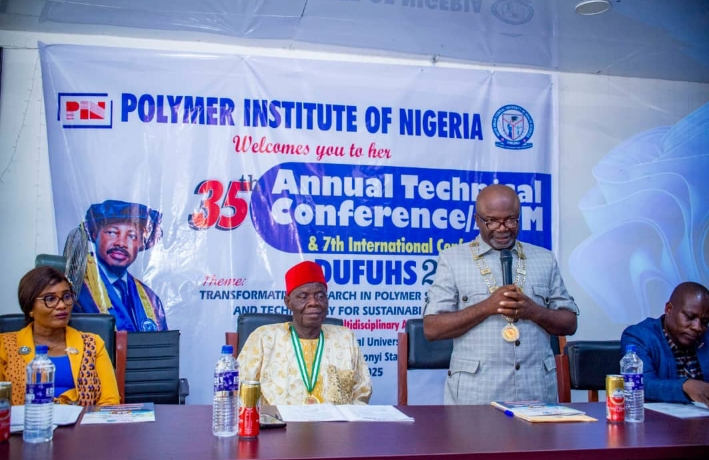
Professor Uneke made the call while declaring the 35th Annual Technical Conference and Annual General Meeting (AGM) of the Institute open, held at the DUFUHS campus in Uburu. The conference, themed “Transformative Research in Polymer Science, Engineering and Technology for Sustainable Development – A Multi-Disciplinary Approach,” brought together experts and stakeholders from across the country.

Represented by the Deputy Vice Chancellor (Academics), Professor Clementina Igwebike Ossi, who also served as the Chairman of the National Organising Committee for DUFUHS 2025, Uneke stressed the need for multi-disciplinary collaboration and innovation in tackling societal challenges.
He said, “Let us focus on transformative research that will solve societal problems. Climate change, for instance, is a multifaceted challenge that requires a multidimensional approach.” He encouraged scientists to create knowledge that advances polymer research and contributes to sustainable solutions for environmental and developmental issues.
The Vice Chancellor also reaffirmed the core mandate of the Polymer Institute of Nigeria, which includes promoting research, production, and application of polymer materials for the advancement of mankind.
Welcoming delegates to the conference, the National President of the Institute, Professor Paul Ejikeme, commended the management of DUFUHS for their hospitality and support in hosting the event.
In a keynote paper titled “Instruments of Managing Single-Use Plastic Pollution,” the Director of Environment for Development (EFD) Nigeria, Dr Nnaemeka Andegbe Chukwuone, highlighted the dangers of rising plastic pollution. He noted that increased production and consumption of plastics have led to higher environmental contamination, worsened by inefficient waste management systems.
“Plastic pollution in Nigeria is widespread due to high consumption and poor waste disposal practices. Every year, an estimated 19 to 23 million tonnes of plastics enter the ocean, polluting the environment and threatening ecosystems,” he stated.
The event was attended by leading academics and industry experts, including the Chairman of the Board of Trustees of the Institute, Chief Alexis Ajuebon, represented by S. H. O. Egbo; the Vice Chancellor of Bayero University, Kano, represented by Magajji; Dr Chukwuone; and members of the Polymer Institute of Nigeria, among others.
The conference concluded with a renewed commitment by the Institute to deepen research collaborations, promote sustainable polymer technologies, and support Nigeria’s drive toward achieving the Sustainable Development Goals.