The Anambra Creed: From Identity to Character
By Paul Nwosu PhD || AlphaTimes
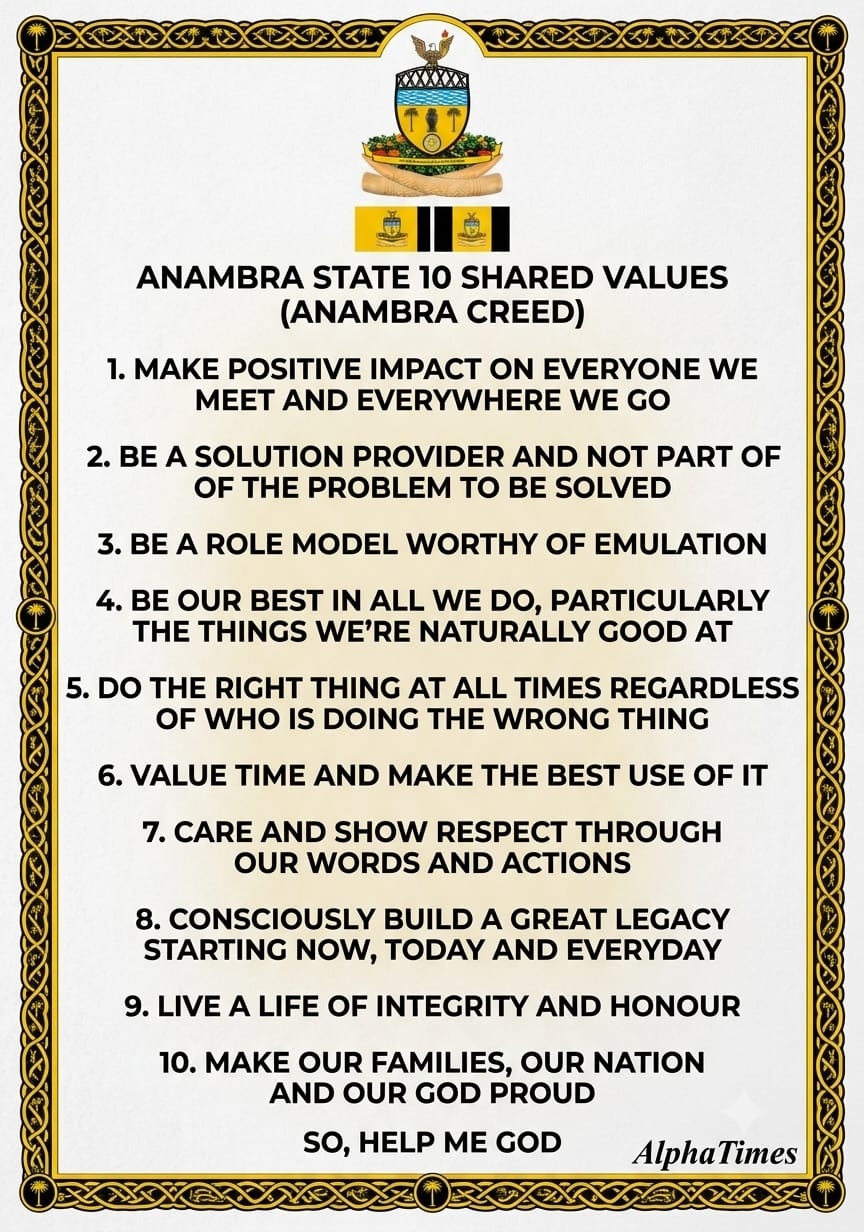
Having examined the vision that gave birth to Brand Anambra, the thinking behind the State’s new identity, the anthem and the symbolism embedded in the Coat of Arms, we now come to what, perhaps, is the most important component of the entire exercise: the Ten Shared Values—the Anambra Creed.
While a logo can identify a people, an anthem can give them a voice, and a Coat of Arms can tell their story, it is their Shared Values that determine how they behave.
This was the point at which Brand Anambra moved beyond branding as a communication strategy and entered the realm of character reformation.
The Ten Shared Values were designed as a simple but profound code of behaviour – principles that could guide Ndi Anambra in their daily interactions, choices, work and responsibilities. Their real power, however, does not lie merely in being written down, taught in schools or recited at public functions. Their power lies in being internalised until they become part of the natural character of the people.
The first five values provide a good starting point.
- Make positive impact on everyone we meet and everywhere we go
This is a powerful call to personal responsibility.
It challenges every Onye Anambra to leave people, places and situations better than they were found. It transforms the idea of being a good citizen from something abstract into a daily obligation.
Whether at home, in business, in public office, at school, in the marketplace or anywhere else, the question is: What positive difference did my presence make?
A society in which people consciously seek to make positive impact will naturally become more humane, productive and progressive.
- Be a solution provider and not part of the problem to be solved
This value speaks directly to the entrepreneurial spirit for which Ndi Anambra are widely known.
It encourages a mindset that does not merely identify problems but asks: What can I do to solve them?
It is the mentality of the entrepreneur, the innovator, the professional, the public servant and the ordinary citizen who refuses to sit back and complain when something can be done.
The message is particularly relevant in public life. Rather than becoming another burden on society, every citizen should aspire to become part of the solution.
- Be a role model worthy of emulation
Leadership is not confined to political office.
Every parent, teacher, businessman, professional, traditional ruler, religious leader, public servant and community leader influences somebody. Even ordinary citizens are constantly being watched and unconsciously imitated.
This value therefore places a moral responsibility on every Onye Anambra to live in such a manner that others can safely follow his or her example.
It is a call to consistency between what we preach and what we practise.
A State cannot build a culture of excellence if its people celebrate conduct they would not want their children to imitate.
- Be our best in all we do, particularly the things we’re naturally good at
This value recognises a fundamental truth about Anambra. Talent is abundant, but talent must be developed and excellence must be pursued.
It calls Ndi Anambra not merely to participate, but to strive for excellence in whatever they choose to do.
Whether in education, medicine, technology, agriculture, commerce, manufacturing, public service, the creative industry or any other field, the challenge is to discover one’s natural gifts, develop them and deploy them to the fullest.
In a competitive world, being good is no longer enough. The goal must be to become the best version of oneself and to turn individual gifts into collective progress.
- Do the right thing at all times regardless of who is doing the wrong thing
Perhaps no value tests character more than this.
It is easy to do the right thing when everybody around us is doing it. The real test comes when wrongdoing appears to have become the norm.
This value therefore rejects the dangerous excuse that “everybody is doing it.”
Integrity cannot depend on who is watching, who is involved or what others are doing. The right thing remains right even when it is unpopular, inconvenient or costly.
For Brand Anambra to become a culture rather than a campaign, this principle must become instinctive. We should do what is right because it is right.
And this is where the long-term significance of the Ten Shared Values becomes evident.
A creed of this nature cannot produce its full effect in one administration or within a few years. Values require time to move from the pages of a document into the consciousness of a people.
They must be taught repeatedly, demonstrated by leaders, reinforced in schools, reflected in public institutions and practised in homes and communities.
That is why such a civic culture should not be treated as the property of one political administration.
The fact that the Ten Shared Values were developed under a previous administration should not diminish their relevance. If anything, their survival beyond the administration that created them would be evidence that the values belong to the people and not to the politicians who introduced them.
There is a danger when every new administration feels compelled to discard the ideas of its predecessor simply because they bear the predecessor’s political imprint. A society cannot build enduring values by starting afresh every four or eight years.
If one administration begins teaching a code of behaviour and the next abandons it for another, and the next one does the same, the people never have enough time to internalise any of them.
But if successive administrations sustain the campaign, irrespective of who created it, the values can gradually become part of the social DNA of the State.
Imagine a time when a child grows up hearing these principles at home and in school; sees them reinforced by government; encounters them in public institutions; and hears them repeated throughout society.
Eventually, they cease to sound like instructions. They become the expected way of life.
And when that happens, the person who behaves contrary to them begins to look like the outcast, not because government is forcing compliance, but because society itself has developed a strong moral expectation of acceptable behaviour.
That is the real promise of the Anambra Creed.
The first five values tell us what kind of person an Onye Anambra should strive to become.
The final five take that journey further, from personal discipline to time, respect, legacy, integrity, honour, family, nation and God.
(Read the concluding Part (6) tomorrow. In case you missed any installment, visit: www.alphatimes.ng)