By Paul Nwosu PhD || AlphaTimes
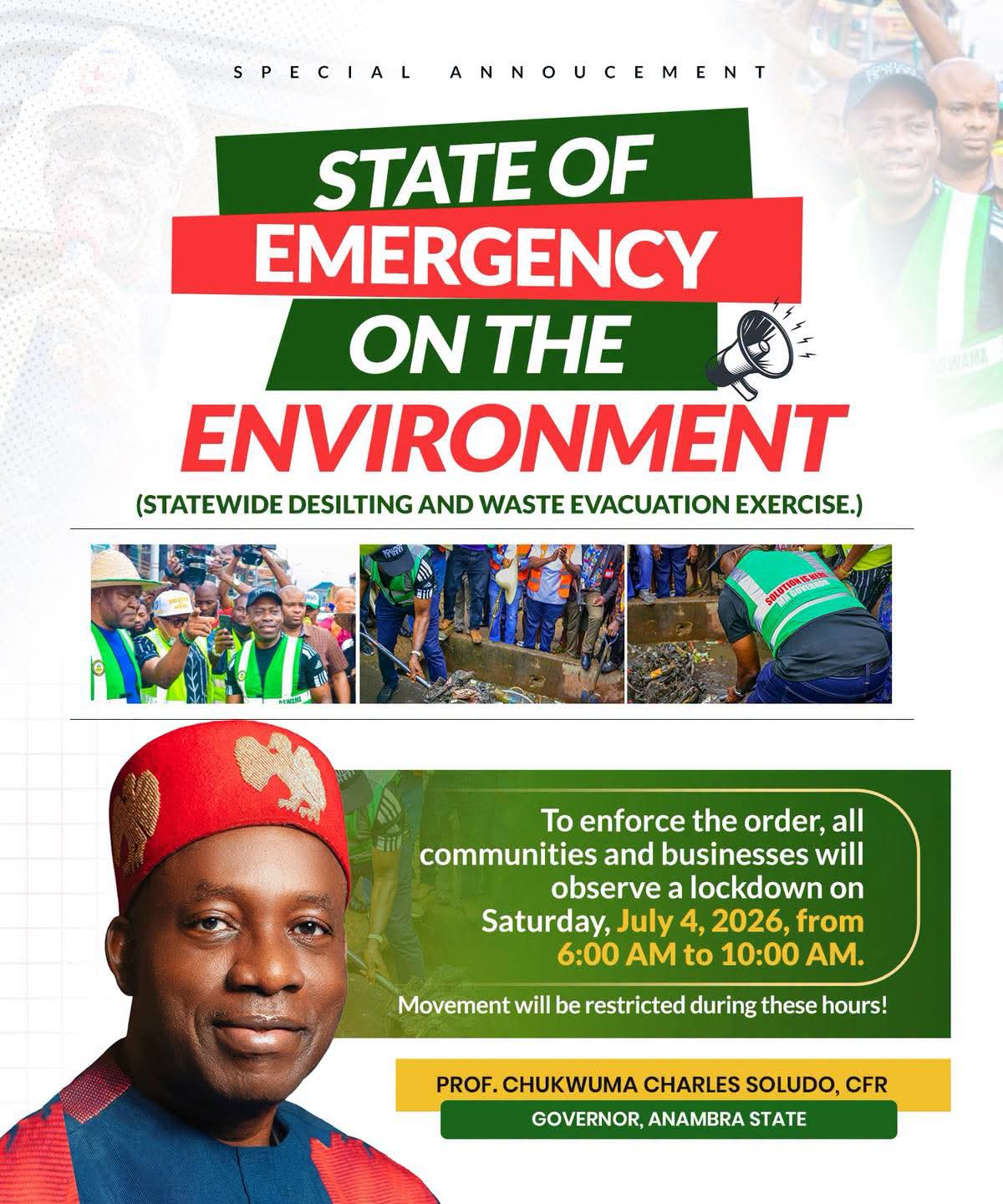
Governor Charles Chukwuma Soludo’s declaration of a state of emergency on the environment on July 4 to facilitate the desilting of drainage channels and other sanitation exercises is both timely and commendable. With the rainy season in full swing, proactive measures to prevent flooding are necessary and deserve public support.
Indeed, periodic environmental sanitation has become one of the hallmarks of the Soludo administration. Many still remember that early in his first term, Governor Charles Chukwuma Soludo personally supervised the evacuation of the vast expanse of refuse at Okpoko and the mountain of garbage that had overwhelmed Ochanja Roundabout in Onitsha. Since then, the state has embarked on four major environmental interventions—in 2023, 2024, 2025 and now the 2026 State of Emergency on the Environment.
Each time, the same familiar spectacle unfolds, sycophantic market associations, transport unions, landlords’ and tenants’ associations, schools, churches and neighbourhood groups suddenly spring into action. Armed with brooms, rakes and shovels, they hurriedly clear drains and sweep their surroundings, often more for optics than out of a sustained commitment to environmental cleanliness. As we say in local parlance, much of it is simply “eye service.”
Almost as soon as the exercise ends, the Governor and his entourage depart, and the swamp buggies and excavators borrowed from construction companies are returned, life slips back to “business as usual.” With the next heavy rainfall, much of the refuse and debris find their way back into the very drainage channels that had just been painstakingly cleared.
Therein lies the irony. This administration once argued, quite convincingly too, that setting aside a particular day every month for environmental sanitation amounted to unnecessary histrionics that merely played to the gallery. Its position was that sanitation should be a daily civic responsibility, not a monthly or periodic ritual imposed by government fiat.
There was considerable wisdom in that position. Cleanliness is most effective when it becomes a habit rather than an event. That is why the present cycle of recurring environmental emergencies raises an important question: are we merely managing the consequences of environmental abuse, or are we prepared to confront its root causes?
Historically and culturally, Ndi Anambra were known for their culture of cleanliness. Before urbanisation transformed our communities into sprawling metropolitan centres, families routinely woke up every morning to sweep their homes and compounds before disposing of refuse at designated communal dump sites. Cleanliness was not enforced by government; it was a way of life.
It is therefore surprising that we now appear to be returning to periodic sanitation exercises, and under the more dramatic title of a “state of emergency” on the environment.
It is still my believe that the old culture of keeping our surroundings clean every day remains the ideal. However, it must also be acknowledged that rapid urbanisation, population growth and the heterogeneous nature of our cities have significantly eroded those communal values. If the daily sanitation culture has indeed diminished, then government should respond with policies that address the root causes of environmental degradation rather than recurring emergency exercises after which our environment gradually returns to its former state.
Recent sanitation and desilting exercises reveal one unmistakable pattern. More than 80 per cent of the waste removed from blocked drainage channels consists of disposable plastic materials such as water sachets, plastic bottles, Styrofoam food packs, takeaway containers, disposable cups, straws and lightweight nylon bags.
Now that Governor Soludo has his second term firmly in his pocket, he possesses both the political capital and the freedom to take bold decisions that politicians often avoid because of electoral consequences.
The first step should be a phased ban on single-use plastic products. Lagos State implemented a similar policy after allowing manufacturers, distributors and consumers a reasonable transition period to adopt environmentally friendly alternatives. There is every reason for Anambra, a highly commercially oriented state, to do the same.
These plastics are among the principal causes of blocked drainage systems and overflowing sewage channels, leading directly to flooding whenever heavy rains occur. Every desilting exercise merely removes yesterday’s plastics while making room for tomorrow’s.
Beyond the environmental damage lies an even greater concern for public health. Scientific research has increasingly shown that many plastic products release harmful chemicals into food and water, while their gradual breakdown produces microplastics that eventually find their way into the human body through drinking water and the food chain. Although many citizens remain unaware of these dangers, government has a duty to protect public health by reducing unnecessary exposure to these hazardous materials.
A ban will achieve little without effective enforcement. Enforcement however must not resemble the selective approach too often associated with the OCHA Brigade, where street traders appear to be the only visible targets. It should extend to every individual who indiscriminately discards waste, from sweet wrappers and water sachets to plastic bottles and food containers. Environmental responsibility cannot be reserved for the poor while others litter with impunity.
Government should also enlist the active participation of institutions that shape public behaviour such as markets, motor parks, schools, churches and other public places which should necessarily become partners in implementation. Waste bins must be strategically located and regularly emptied. Commercial buses should be required to carry small waste receptacles so that passengers will have no excuse for throwing wrappers and bottles onto the streets. Drivers who fail to provide them should be held accountable.
Enforcement should also be backed by swift prosecution and meaningful penalties. Environmental laws only command respect when violations carry predictable consequences.
Equally important is sustained public enlightenment. The campaign should go beyond television, radio and social media. Traditional communication channels remain highly effective. Town criers should carry the message into markets and communities. Churches should incorporate environmental responsibility into their announcements after Mass or Service. Schools should reinforce the message during morning assemblies until proper waste disposal becomes second nature to every child.
Environmental sustainability cannot be built on occasional declarations of emergency. It is achieved through consistent public education, sensible legislation, effective enforcement and, above all, policies that confront the source of the problem rather than its consequences.
Governor Soludo deserves credit for placing environmental sanitation high on the public agenda. But if this renewed emergency campaign is to leave a lasting legacy, it must move beyond clearing clogged drains after the damage has been done. The real challenge is preventing those drains from being blocked in the first place.
If Anambra succeeds in doing so, one of the greatest achievements of this administration will not be the number of sanitation exercises it organised, but the fact that, by tackling the root cause of the problem, such emergency exercises gradually became unnecessary.
Becoming another Rwanda within Nigeria is possible.