Valentine Obienyem
I became an addict of Will Durant quite by chance. Before I entered the university in the early 1990s, I was already contributing opinion pieces to national dailies. Dr. Okey Ikechukwu (now a Professor) would always give me topics to write on. In a bid not to disappoint him, myself, or my readers, I would visit the library in the course of my research. Sometimes, he would ask me to research certain topics and report back to him. The modest monthly stipend took care of my necessary transportation.
On one occasion, while browsing through books that might catch my fancy, I stumbled upon an eleven-volume work titled “The Story of Civilization.”
The complete volume:
Our Oriental Heritage
The Life of Greece
Caesar and Christ
The Age of Faith
The Renaissance
The Reformation
The Age of Reason Begins
The Age of Louis XIV
The Age of Voltaire
Rousseau and Revolution
The Age of Napoleon
I initially leafed through some of the volumes rather casually, but within a short time, I became captivated by Durant’s extraordinary command of language. His ability to transform history into a beautiful narrative fascinated me. I eventually read all eleven volumes from cover to cover two times.
The only person who would probably exclaim, “No wonder!” on hearing this is my friend, Mr. Emmanuel Chiadi. We were younger then, and we both frequented the beautiful and serene CBAAC Library at the National Theatre, Lagos. In those days, the library was still a functioning intellectual sanctuary, with facilities that welcomed anyone with a hunger for knowledge. I do not know if it still functions now.
I would often stand at the entrance of the library, waiting for it to open for the day because I usually arrived before the staff. One of my daily distractions in the library was spending about two hours reading all the daily newspapers and magazines available. While I was immersed in reading, Emma, in his characteristic manner, would draw me into political discussions. He had an impressive grasp of politics, tracing events and personalities from the days of Herbert Macaulay and beyond.
Around 1 p.m., I would stroll out to look for food before returning to continue my reading. By about 5p.m., Emma and I were often among the last people remaining in the library. The staff would gently tap us and remind us that they were about to close. Looking back, those were some of the most formative moments of my life.
When I reflect on my literary flowering and the people who shaped my intellectual journey, I can confidently say that Fr. Collins Okeke led the way. He mesmerised us with knowledge and made me love philosophy at a very early stage of my life, even when I did not fully understand the path he was opening for me. I think “The Touch” magazine made it easier, because I read it voraciously then and dissected the contributions of young seminarians showcasing their mastery of philosophy.
Then came Prof. Okey Ikechukwu. His influence on me was profound and complete. He shaped my understanding of philosophy, journalism, and life itself. His was not merely an academic influence; it was a mentorship that affected the way I think, write, and engage with the world.
Then came Will Durant. I do not know of any author who has come close to Durant in his ability to make knowledge accessible, beautiful, and deeply human. He believed that every branch of knowledge has the duty to be intelligible or keep quiet. Through him, history was no longer a collection of dates, wars, and names; it became a living story of humanity – our struggles, aspirations, triumphs, philosophies, failures, discoveries, and endless search for meaning. I have not encountered any language as seductive as his.
Durant had a rare gift for bringing the greatest minds humanity has produced into conversation with ordinary readers. Through his writings, philosophers, historians, artists, scientists, statesmen, and thinkers who shaped the destiny of civilizations became accessible companions rather than distant figures confined to academic texts. When writing about Plato, for example, he would reduce his philosophy to the “unreal seen and the unseen real.”
He brought Socrates, Aristotle, Confucius, Shakespeare, Voltaire, Rousseau, Napoleon, and countless other giants of human thought into my intellectual world. They were no longer mere names in books; they became voices in a continuing conversation about humanity – its achievements, weaknesses, and aspirations.
After finishing “The Story of Civilization”, I developed an irresistible desire to read it again and again. When the CBAAC Library was undergoing renovation, I discovered the National Library along Herbert Macaulay Way, Yaba. Since I lived on Desalu Street, Ebute Metta, I would trek to the library through the railway compound. Thankfully, the National Library had the complete set of volumes, and I continued my journey with Durant.
In 2002, while reviewing Prof. Okey Ikechukwu’s 1993 book, “The Philosophy of Philosophy”, I noticed that he quoted extensively from some of Durant’s other works. In one of our discussions, it was through him that I learnt about Durant’s broader body of work.
In 2006, I read Prof. Josephat Obi Oguejiofor’s Philosophy and the African Predicament and noticed that he also quoted Durant extensively. At the time, he was the Rector of Bigard Memorial Seminary, Enugu. I requested my younger brother, who was studying there, to kindly ask him if he had the complete volumes of Durant’s works. Prof. Oguejiofor graciously released them to my brother for photocopying, as I could not find them in the market.
At that time, I spent about ₦70,000 through my brother to photocopy and bind the collection. It was a significant sacrifice, but the joy of finally owning copies of works I had searched for so long was immeasurable.
Later, I discovered that I could purchase Durant’s works directly from Amazon. I bought ten sets at close to a million Naira. I kept one set for myself and reserved three sets each for my three children. I have always believed that introducing them to Durant would be one of the greatest intellectual gifts I could give them.
In fact, while trying to declutter his room, my son once moved the books to the store. When I discovered this, I asked him to return them to his room after explaining to him that these books represented some of the greatest inheritances I could leave for my children – not merely as physical objects, but as treasures of knowledge and intellectual formation.
How do I thank Prof. Okey Ikechukwu for his mentorship? What better gift could I give him than a set of books that profoundly shaped my intellectual journey? I gave him one set.
I also gave one set to Prof. Mmaduabuchi Dukor, who, as Head of Department at Lagos State University, offered me admission to study Law. Other sets went to the then Accountant-General of Anambra State, Mr. Romanus Ogbogu; the Secretary to the State Government, Mr. Ezeoke; Prof. Emenike Obi; and Ambassador Mike Udah.
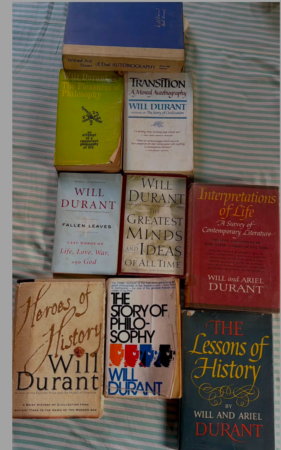
With time, I acquired other works by Will Durant apart from “The Story of Civilization.” These include “Philosophy and the Social Problem”; “The Story of Philosophy,” one of the greatest introductions ever written to the lives and ideas of the world’s great philosophers; “Transition”; “The Mansions of Philosophy” (later revised as “The Pleasures of Philosophy”); “The Case for India”; “Adventures in Genius”; “On the Meaning of Life”; “A Program for America”; “Interpretations of Life”; “The Lessons of History,” which he wrote with Ariel Durant; “A Dual Autobiography,” which chronicles their remarkable intellectual partnership; “Heroes of History”; “The Greatest Minds and Ideas of All Time”; and “Fallen Leaves: Last Words on Life, Love, War, and God,” published posthumously in 2014.
I have also read his available articles and papers presented at various functions. Every additional work only deepened my admiration for his mind and his ability to engage with the most profound questions of human existence.
“Fallen Leaves” was particularly fascinating because it represented Durant’s final reflections on some of the deepest questions that occupied his mind throughout his life: human existence, morality, religion, suffering, war, love, and the search for meaning. It was like the final conversation of a great mind with humanity.
Reading Durant was not merely reading history or philosophy; it was entering into a conversation with civilization itself. He taught me that history is ultimately the story of humanity – of our dreams and failures, our wisdom and follies, our search for truth, and our eternal quest to understand ourselves.
To show how fascinated I am with Will Durant, I discovered that Prof. Ben Nwabueze quoted him extensively in his books. When I met him and mentioned Will Durant, he spent the next thirty minutes telling me that he had not encountered a writer and intellectual quite like him. I can say with confidence that no celebrated writers and intellectuals pale in comparison to Durant’s extraordinary breadth, clarity, and ability to communicate the entire journey of civilization.
On one occasion, Prof. Oguejiofor invited me to his office. We discussed many things, including politics and public affairs. In the course of our conversation, he made a remark that stayed with me. He said, “Val, you know politicians are the same. Your man said that ‘men lie most when they govern states.’ ”
Immediately, I knew he was referring to Will Durant. Such was my familiarity with Durant’s thoughts and writings that a simple allusion was enough for me to identify the source. It was not merely that I had read Durant; I had absorbed his reflections on human nature, power, ambition, and the recurring patterns of history.
Durant would perhaps describe such an association as an act in the country of the mind, where people separated by time and circumstance meet through the shared language of ideas. In that realm, books become bridges, and great thinkers continue conversations with those who encounter their works long after they have departed.
That moment with Prof. Oguejiofor reminded me that intellectual companionship is not always built through physical proximity. Sometimes, a person we have never met becomes a lifelong companion because their thoughts inhabit our minds and shape the way we see the world.
The immediate trigger for this recollection was an experience with my daughter as she prepared to return to school. She asked to take “The Lessons of History”, one of Durant’s books, with her. She assured me that she would not lose it because, as she observed, other students would not be interested in such books.
My greatest happiness was that she had started developing an interest in Durant. After her WAEC examinations, I intend to gradually introduce her to his major works. That a new generation is beginning to discover the same intellectual treasure that shaped me gives me immense joy.
Perhaps this is the greatest legacy books can offer: they allow one generation to hand over the wisdom of the past to another. Through Durant, I found a companion, a teacher, and a window into the vast story of humanity. My hope is that my children and those who come after them will continue that conversation.