By Polycarp Onwubiko | AlphaTimes
The late Dr Nnamdi Azikiwe, Nigeria’s first President, never possessed the mystical powers of disappearing and reappearing, as widely suggested in popular folklore, his surviving wife, Prof. Mrs Azikiwe, has clarified.
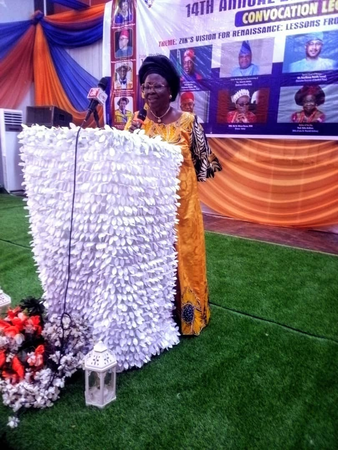
She made the disclosure at the 14th Nnamdi Azikiwe Zik Lecture Series held at the ASUU Secretariat, Nnamdi Azikiwe University, Awka, where she dismissed the popular legend that her husband regularly disappeared and reappeared through encounters with a mythical female spiritual being known as Mammy Water in the River Niger.
According to the folklore, Zik engaged the mysterious river spirit in a contest of spiritual supremacy, supposedly representing a struggle against British colonial domination and the quest for Nigeria’s independence.
The story claimed that while Mammy Water could not transform herself into a tiny creature and enter a bottle, Zik allegedly transformed into an ant, entered the bottle and returned to his normal human form. When the spiritual being subsequently entered the bottle, Zik was said to have quickly retrieved its cover and sealed it, thereby trapping her.
The legend further suggested that this supernatural victory paved the way for Nigeria’s independence from Britain.
However, Prof. Mrs Azikiwe dismissed the account, insisting that although her husband was an extraordinary personality, he never possessed such mystical abilities.
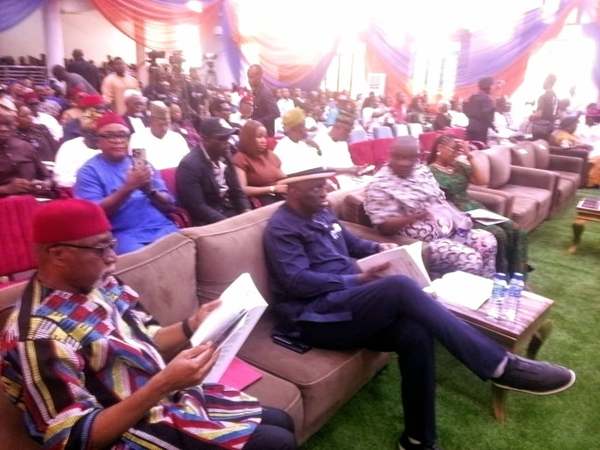
“My husband was too much, but he never disappeared and reappeared as a mystical Zik,” she declared, drawing laughter from the audience.

She said her husband left behind an enduring legacy worthy of preservation and commended the university management, particularly Senator High Chief (Dr) Ben Ndi Obi, Ojeligbo Ndigbo and Oku Uzu na Agbaze Igwe Awka, for initiating and sustaining the lecture series for 14 consecutive years.
She appreciated the recognition accorded her late husband, noting that while his achievements had received widespread acclaim, his shortcomings as an ordinary human being were often overlooked.
Prof. Azikiwe also expressed gratitude to former Head of State, General Ibrahim Babangida, for naming the university after her husband, assuring that the Azikiwe family would remain grateful to Senator Ndi Obi and the institution.
She urged the students to uphold the values and ideals of the late statesman, particularly his enduring philosophy: “Show the light and the people will find the way.”
Ndi Obi Sustains Zik’s Intellectual Legacy
In his welcome address, the Dean of the Faculty of Social Sciences, Prof. Michael Onyeka Ezenwa, who is also Country Director of the International Consortium of Universities for Drug Demand Reduction (ICUDDR) and former National President of the National Psychological Association, commended the guests and acknowledged Senator Ndi Obi’s consistent support for the Zik Lecture Series.
He described the 14th edition’s theme, “Zik’s Vision for Renaissance: Lessons from Emerging Economies in Africa,” as particularly relevant to the continent’s quest for economic independence, educational advancement and sustainable development.
Prof. Ezenwa disclosed that Senator Ndi Obi and his wife, Chief Mrs Chiaka Ndi Obi, were also establishing a legacy edifice within the university.
According to him, the completed facility will house the Senator Ndi Obi Institute for Governance, Legislative Studies and Research on Zik’s Political Ideology.
He expressed optimism that the institute would become an international centre where scholars, researchers and students could study and engage with the political philosophy and ideological contributions of the late Owelle of Onitsha.
Explaining the theme, Prof. Ezenwa said Africa must redefine its development priorities by embracing self-determination, strengthening its economy and educational institutions, and developing homegrown solutions rather than depending excessively on externally packaged development partnerships and foreign aid.
He called for greater investment in indigenous technology and intellectual capacity, expressing hope that the lecture series would inspire African leaders and citizens to look inward for sustainable solutions to the continent’s challenges.
He also noted that the Vice-Chancellor of Nnamdi Azikiwe University, Prof. Ugochukwu Bond Stanley Anyaehie, shares the November 16 birthday with the late Dr Azikiwe.
Ndi Obi: Zik Lecture Series Must Inspire Responsible Leadership
In his address, Senator Ben Ndi Obi, founder and principal benefactor of the Zik Lecture Series, expressed gratitude to God and satisfaction that the intellectual initiative had endured for 14 years.
He described the gathering as a celebration of the life, philosophy and enduring contributions of Dr Nnamdi Azikiwe, whom he regarded as his mentor, teacher and leader.
He said the occasion was particularly significant as it coincided with activities marking Zik’s birthday, the university’s Founder’s Day and its convocation ceremonies.
Senator Ndi Obi acknowledged the contributions of Prof. A.U. Nonyelu, whom he described as the academic adviser whose initial encouragement inspired the establishment of the lecture series.
He appreciated his continued advice and commitment over the years.
He expressed the hope that the Zik Lecture Series would remain a beacon of intellectual excellence, a platform for constructive engagement and a catalyst for responsible leadership and national development.
He also prayed that Zik’s legacy would continue to inspire Nigerians and Africans to pursue knowledge, uphold justice, strengthen democracy and work towards a united, prosperous and dignified continent.
Abaribe Warns of State Capture, Says Nigeria Risks Anarchy
The keynote address, delivered by Distinguished Senator Enyinnaya Abaribe, representing Abia South Senatorial District, was titled “State Capture and a Possible Descent into Anarchy.”
Abaribe, who described himself as a student of Zik’s leadership philosophy, said it was a profound honour to deliver the keynote at an intellectual gathering dedicated to the memory of one of Africa’s greatest nationalists.
He recalled that the lecture series had attracted distinguished personalities, including former presidents, vice-presidents, diplomats, governors, scholars and legal luminaries.
He said Zik represented a model of visionary leadership anchored on a clear philosophy, explaining that his influence extended beyond political power to education, national reorientation, the struggle for freedom, infrastructural development and the emancipation of Africans.
He cited Zik’s contributions to the establishment of the Zikist Movement, Nigeria Cement Company, Niger Steel, the Eastern Nigerian Development Corporation and the University of Nigeria, Nsukka, as examples of his commitment to building institutions and advancing national development.
He also highlighted Zik’s strategic use of the media to promote African freedom and development.
According to him, Nigeria and several African countries have continued to struggle with leadership deficiencies decades after Zik’s departure because successive generations have failed to sustain the principles he championed.
Invoking the philosophy of the West African Pilot, “Show the light and the people will find the way,” Abaribe said his intention was to expose the country’s fundamental challenges and encourage collective efforts towards finding lasting solutions.
Education and the Widening Gap Between Morality and Immorality
Abaribe identified the growing disconnect between education and moral values as one of Nigeria’s major developmental challenges.
He recalled that the philosophy of education promoted by Zik and other nationalists went beyond literacy and academic qualifications to include character formation, self-reliance, discipline and excellence.
He cited the motto of Nnamdi Azikiwe University, “Discipline, Self-Reliance and Excellence,” and that of the University of Nigeria, Nsukka, “To Restore the Dignity of Man,” as reflections of the transformative ideals that informed the country’s early educational vision.
He regretted that education, which should produce individuals of sound character and learning, increasingly appeared to emphasise academic qualifications at the expense of moral development.
The senator also expressed concern about the influence of unrestricted social media exposure on young people, particularly the glorification of materialism, violence and casual relationships.
While acknowledging the benefits of social media as a source of information and learning, he warned that its negative influences could undermine values such as honesty, empathy, respect, hard work and responsibility.
He argued that the educational system must return to the principle of producing graduates who are not only academically competent but also morally upright.
Ill-Gotten Wealth and the Celebration of Criminality
Another major concern raised by Abaribe was the growing social acceptance of unexplained wealth, particularly among young people.
He described the phenomenon as the glorification of “ego mbute” (ill-gotten wealth), lamenting that society no longer appears sufficiently interested in questioning the sources of sudden riches.
He recalled that wealth was traditionally respected when it could be traced to legitimate enterprise, hard work and productive investments.
Today, he argued, the increasing celebration of unexplained affluence has created an environment in which deception and criminality are sometimes rewarded more generously than diligence and honest labour.
Commending Governor Chukwuma Soludo for efforts to clamp down on individuals allegedly using idolatrous and fraudulent practices to create the impression that wealth can be acquired through supernatural means, Abaribe warned that society must urgently restore the dignity of legitimate enterprise.
“A young person who learns at fifteen that deception pays better than diligence may never discover the dignity of honest labour,” he observed.
He warned that the consequences could be disastrous, particularly because Nigeria’s electoral process increasingly rewards financial power above competence and character.
He cautioned that unless society rejected the celebration of illicit wealth, individuals involved in ritual killings, human trafficking, internet fraud and other criminal activities could eventually emerge as political leaders.
State Capture: The Ultimate Leadership Failure
The senator identified state capture as the most dangerous manifestation of leadership failure in Nigeria and other parts of Africa.
Drawing on the definition by Elizabeth Dávid-Barrett, he described state capture as a form of systemic corruption in which narrow interest groups take control of public institutions and policymaking processes, directing them away from the public interest to serve private interests.
He stressed that state capture was not peculiar to Africa, citing Hungary under Viktor Orbán, Serbia under Aleksandar Vučić, Angola during the Dos Santos administration and Sri Lanka under the Rajapaksa family as examples of countries where similar tendencies had been identified.
However, he expressed concern that Nigeria was increasingly experiencing a situation in which a small group of individuals had appropriated state institutions and processes for their personal interests.
According to him, institutions established to serve the general population were gradually being manipulated to protect the interests of a privileged few.
He cited concerns surrounding the perceived independence of the electoral body, the effectiveness of legislative oversight, the credibility of the judiciary and the alleged misuse of security agencies against political opponents and young Nigerians.
He also criticised what he described as the growing politicisation of public appointments, employment opportunities, government contracts and infrastructural development.
Abaribe warned that when public institutions lose their independence and credibility, citizens gradually lose confidence in the entire democratic system.
He referenced the warning by journalist Olusegun Adeniyi that if Nigerians begin to regard the judiciary as an extension of the political arena, the country could arrive at a destination from which there would be no easy return: anarchy.
The senator further expressed concern over the alleged use of state institutions to intimidate opposition figures, weaken political competition and promote the interests of those in power.
He also questioned the propriety of government-sponsored housing gifts to members of the judiciary, arguing that such gestures could create perceptions of executive influence over an institution constitutionally expected to remain independent.
According to him, state capture does not always require the outright violation of existing laws. It can also operate through the manipulation of policies, legal interpretations, institutional processes and democratic procedures to achieve predetermined interests.
He explained that when public institutions are systematically influenced to favour a select group, the result is a breakdown of the moral principles that should guide governance, even where the actions appear technically lawful.
To illustrate the imbalance in public spending, Abaribe recalled a June 2024 debate in the Senate over the non-payment of contractors who had completed government projects.
He cited the contribution of former Bayelsa State Governor and serving Senator Seriake Dickson, who observed that recurrent expenditure had been released while capital expenditure remained outstanding.
Dickson had argued that government appeared more interested in funding areas that directly benefited those in power while neglecting capital projects that served the wider population.
Abaribe said the observation aptly captured the state-capture phenomenon, where the interests of a privileged minority take precedence over the needs of the majority.
Moral Decadence and Africa’s Dangerous Future
Abaribe warned that Nigeria and other African countries risked a dangerous future if the prevailing culture of corruption, impunity and moral decadence was allowed to continue.
He argued that the moral failures evident among young people were often reflections of the conduct of the older generation, particularly political leaders and parents.
Using an Igbo proverb, he observed that the young goat naturally watches and learns as its mother chews cud.
He said the combination of leadership failure, unrestricted exposure to negative social influences and the glorification of illicit wealth was creating a cycle of moral decline that could become increasingly difficult to reverse.
He warned that future generations might come to regard corruption, ethnic bigotry, political victimisation, violence, personal aggrandisement and the abuse of public institutions as normal features of leadership.
He expressed particular concern about the increasing loss of confidence among young Nigerians in political leadership and the country’s democratic institutions.
According to him, the country was already witnessing the consequences of this breakdown through insecurity, violent crimes, political intimidation, ethnic divisions and the manipulation of public institutions.
He warned that unless urgent corrective measures were taken, Nigeria could slide further towards anarchy.
Abaribe Charges Students on Character and Excellence
Addressing the students, Abaribe urged them to embrace character development as an indispensable component of education.
He reminded them that the traditional standard of academic excellence was to be “found worthy in character and in learning,” stressing that acquiring technological skills and academic qualifications without sound moral values was insufficient.
He encouraged students to develop the capacity to distinguish useful information from misleading influences, particularly in an era of information overload and unrestricted access to social media.
He also called on lecturers and parents to take greater responsibility for guiding young people beyond classroom instruction and financial support.
According to him, students must learn to critically examine the information they consume, reject negative influences and embrace values that promote personal development and societal progress.
He concluded with a strong appeal to the students:
“There are so many shiny things out there. In this age of information overload, you will also be confused by so many misleading information. My words to you today is to remember one thing: excellence shines beyond all else and endures. Let excellence in character and learning therefore guide you.”
The senator expressed profound appreciation to Senator Ben Ndi Obi and the organisers for finding him worthy to deliver the keynote address.
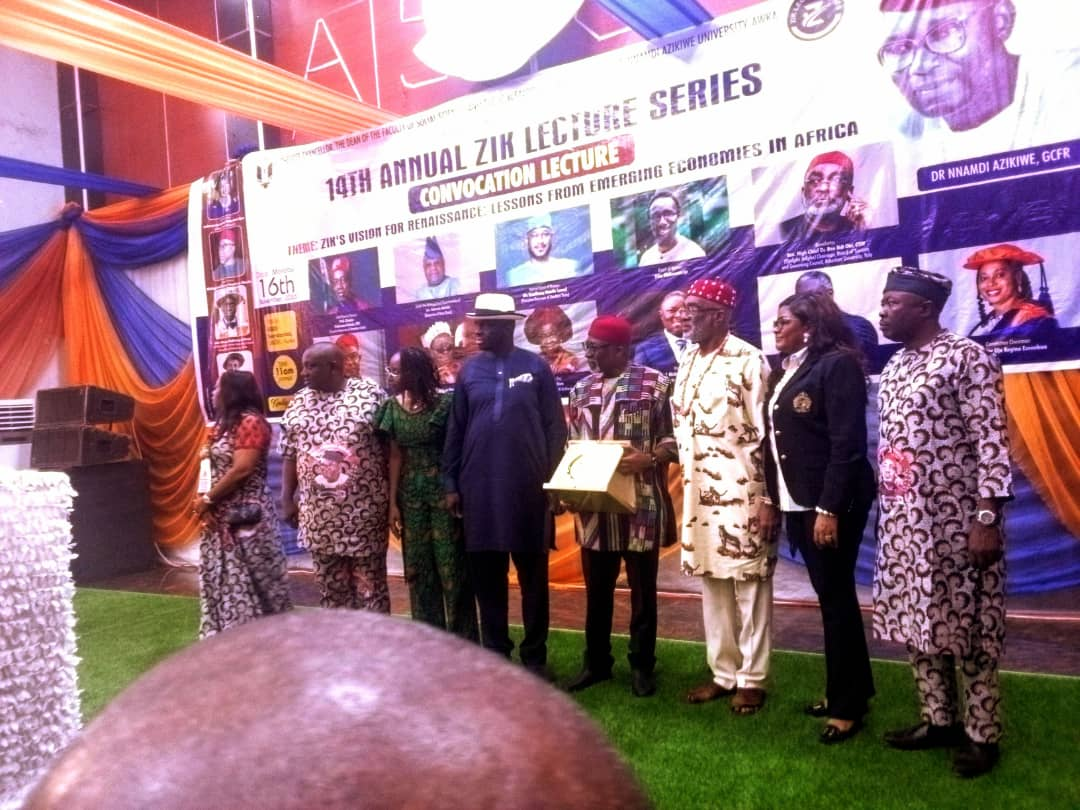
The highlights of the event included the presentation of commemorative memorabilia to Senator Abaribe, cultural performances by the Onitsha Agbalanze cultural team and the prestigious Odunze women, as well as traditional dances by students of the Faculty of Arts.
The occasion attracted prominent personalities from within and outside Anambra State. Osun State Governor, Senator Ademola Adeleke, was among the distinguished personalities expected at the event but was unable to attend following an aircraft-related problem.