By Paul Nwosu, PhD || AlphaTimes
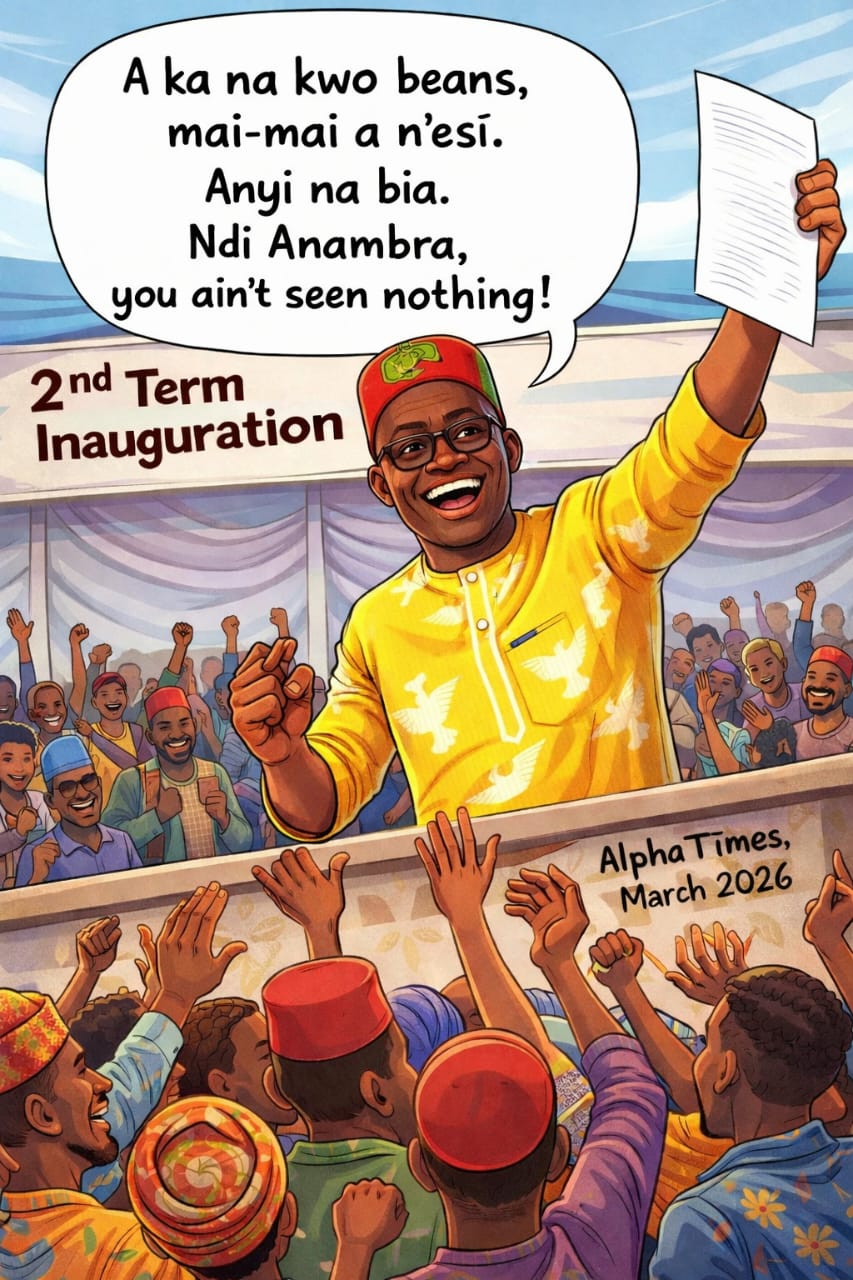
With that confident declaration, Governor Charles Chukwuma Soludo, CFR, set the tone for what promises to be an ambitious, accelerated, and transformational second term in Anambra State.
Standing before a charged audience at the newly expanded Alex Ekwueme Square in Awka, Soludo’s inauguration speech was not merely ceremonial; it was a sweeping manifesto of continuity, consolidation and bold futurism. It was a speech rooted in performance, yet aimed squarely at posterity.
Soludo reminded Ndi Anambra of the stark contrast between his first and second inaugurations. In 2022, there were no drums, no crowds, just a quiet swearing-in followed by nearly nine hours of immediate work. That symbolic austerity, he said, defined an administration that chose action over optics. Four years later, the story has changed.
Armed with what he described as over 90 percent delivery on campaign promises and an unprecedented 73 percent electoral mandate, Soludo framed his re-election not just as a victory, but as validation of a new political culture, one driven by development rather than patronage.
At the heart of the speech was a compelling thesis—that governance anchored on measurable progress can itself become political capital.
Soludo called this emerging model the “Anambra phenomenon”—a people-driven movement where citizens not only voted but actively funded and campaigned for continuity. It is, perhaps, a quiet revolution in Nigerian politics, where performance, not populism, takes center stage.
Central to the governor’s message was the reaffirmation of his long-standing vision to transform Anambra into an African Dubai–Taiwan–Silicon Valley. This triad, he explained, is not just rhetorical jive talk, but a structured development philosophy:
- Dubai for commerce, logistics, and tourism
- Taiwan for industrial productivity
- Silicon Valley for innovation and digital enterprise
Backed by the Anambra Vision 2070 framework, Soludo positioned himself uniquely as both the architect and executor of this long-term blueprint.
The governor then reeled off a catalogue of achievements from dismantling over 60 criminal camps and restoring security across previously volatile areas, to constructing thousands of kilometres of roads and reviving public schools and healthcare systems. The administration’s first phase focused squarely on rebuilding the basics.
Equally striking was the emphasis on human capital. Hundreds of thousands of youths were trained in digital and vocational skills. Free education and healthcare initiatives were expanded, while agricultural empowerment saw millions of seedlings distributed.
But beyond infrastructure and numbers, Soludo underscored a deeper mission in the area of cultural reset. His government, he said, is confronting the dangerous rise of get-rich-quick mentalities and criminal mysticism, pushing instead for a return to the values of hard work and integrity.
If the first term was about stabilization, the second is about acceleration. Tagged “Gear 4.0,” Soludo’s next phase promises a rapid scaling of transformation across multiple fronts, including the development of new cities and economic corridors, the establishment of an innovation district to rival global tech hubs, and the expansion of infrastructure such as rail and gas. The administration will also engage in strategic land banking to secure future urban growth.
Major projects such as the Anambra Mixed-Use Industrial City, an aerotropolis and a massive wholesale trade centre are designed not just as physical structures, but as engines of long-term prosperity.
In a rare moment of introspection, Soludo widened the lens beyond Anambra, addressing the broader Southeast and Nigeria.
He challenged the region to move away from what he termed a “politics of lamentation” and instead embrace strategic coalition-building within Nigeria’s democratic framework. Political relevance, he argued, must be earned through organization and votes, not isolation.
His call for a Southeast “Marshall Plan” and a grassroots movement to “Make Ala-Igbo Great Again” signals a desire to redefine regional engagement in national politics.
Perhaps the most resonant thread throughout the speech was Soludo’s insistence that government alone cannot deliver the future.
From diaspora investors to local communities, he called on every Anambra citizen to play a role by paying taxes, obeying laws, investing in communities and safeguarding security. It is a model of governance that sees citizens not as passive recipients, but as active partners, he stressed.
Soludo struck a personal chord, declaring his desire to build a state where he himself would be proud to retire, and where future generations would thrive. It was both a promise and a challenge.
With bold plans, a strong mandate and a clearly articulated vision, the second term of Governor Charles Soludo may well define not just the trajectory of Anambra State, but also offer a template for subnational governance in Nigeria.
And if his words are anything to go by, a major paradigm shift is only just beginning.