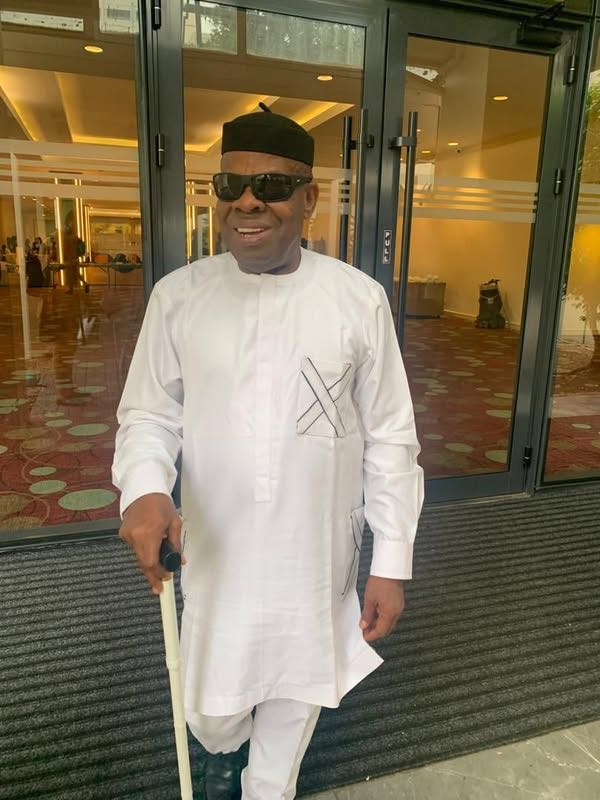
A Clarion Call on the Disability Community
By Chuks Ezewuzie Esq.
Every vote matters. Your vote has no disability. Do not allow your disability to disenfranchise you. Politics is a game of numbers. The disability community’s vote is large enough to tip the election one way or the other. The Anambra State Disability Rights Commission, in partnership with the Independent National Electoral Commission (INEC), has put measures in place to ensure compliance with the requirements of the Anambra State Disability Rights Law 2018 and the Federal Disability Discrimination Prohibition Act of 2018, which guarantee your right to participate in an election.
YOUR VOTE MUST COUNT :
Here’s why — in a democracy, every citizen has the power to shape the future with their vote. But just how powerful is one vote? Let’s explore the impact of a single vote and how it has changed history.
One Vote in Elections
One vote can be the difference between winning and losing. Here are a few examples:
1960 U.S. Presidential Election: John F. Kennedy won the presidency by a margin of just 112,881 votes out of 68 million votes cast. Kennedy won Illinois by a margin of only 8,858 votes, which helped him secure the presidency.
2000 U.S. Presidential Election: Al Gore lost the presidency to George W. Bush by a margin of just 537 votes in Florida, out of over 6 million votes cast.
2017 U.K. General Election: The Conservative Party won a surprise victory, with a majority of just one seat in Parliament. The seat was won by a margin of only 2 votes.
In Nigeria, one vote has also made a significant impact in shaping the country’s future.
In 1999, Nigeria transitioned to democracy after years of military rule. The presidential election was fiercely contested between Olusegun Obasanjo and Olu Falae. The final result showed Obasanjo winning by a margin of just 700,000 votes. One vote in the electoral college could have changed the course of history — but Obasanjo’s victory marked a new era for Nigerian democracy.
One Vote in Project Decisions
Similarly, one vote can guarantee the execution of a project or kill the proposal to establish one:
The Panama Canal: In 1880, a single vote by a French engineer, Philippe Bunau-Varilla, changed the course of history. He voted in favor of building the Panama Canal, which was completed in 1914 and revolutionized global trade.
The Brooklyn Bridge: In 1869, a single vote by a member of the Brooklyn Bridge Company’s board of directors, William C. Kingsley, ensured the project’s funding and completion. The Brooklyn Bridge opened in 1883 and transformed transportation in New York City.
In Nigeria :
In 1983, the Nigerian government planned to establish a new university in the South-South region. The Minister of Education, Professor Ibrahim Gamal, was tasked with selecting the location. The final decision came down to two states: Akwa Ibom and Cross River. The Governor of Akwa Ibom, Colonel Felix Ogar, cast the deciding vote in favor of Uyo, leading to the establishment of the University of Uyo.
In 2001, the Nigerian Government planned to establish the National Open University of Nigeria (NOUN). The proposal was put to a vote in the Federal Executive Council, and one vote by the then Vice President, Atiku Abubakar, broke the tie, leading to the establishment of NOUN. Today, NOUN is one of Nigeria’s largest universities, providing access to education for millions.
The power of one vote also played a significant role in the establishment of the old Anambra State University of Science and Technology (ASUTECH). According to historical records, the Constituent Assembly voted on the location of the university, and Professor Ambrose Alli — a member of the Constituent Assembly and then governor of Bendel State — cast the deciding vote in favor of Enugu, leading to the establishment of ASUTECH in the old Anambra State.
This vote had a lasting impact on the development of education in the region, and ASUTECH’s legacy continues through the institutions that emerged from it, including Nnamdi Azikiwe University, Enugu State University of Science and Technology, and Ebonyi State University Abakaliki (upgraded from ESUT Faculty of Health Sciences).
The institution, Anambra State University of Science and Technology (ASUTECH), was therefore established by Law No. 7 of 1980, passed by the Anambra State House of Assembly on July 30, 1980.
According to the then Governor of Anambra State, Chief Jim Nwobodo, during the signing of the bill into law, the institution was established by a one-vote majority.
Would you imagine that the great Nnamdi Azikiwe University in Awka exists today thanks to the power of one vote?
In Nigeria, every vote matters, and every citizen has the power to make a difference. Make your voice heard and exercise your right to vote. One vote can have a significant impact — whether it’s in a political or project decision. Every vote counts. Do not underestimate the power of your vote. Make it count and shape the future you want to see.
Chuks Ezewuzie Esq.
Chairman Anambra State Disability Rights Commission