By Sir Paul Nwosu PhD.
The Easter Triduum, the most sacred stretch in the Christian calendar, begins with Maundy Thursday (Holy Thursday), a day that commemorates the institution of the Holy Eucharist and the priesthood by Jesus Christ at the Last Supper. It is also a profound lesson in humility, exemplified in Christ’s washing of the disciples’ feet, a gesture that redefines leadership as service.
At the Catholic Church of Visitation, Festac Town, the Mass drew the faithful into this solemn mystery. Yet, the spiritual depth of the liturgy seemed somewhat diminished by the choir’s inability to fully rise to the occasion. Notably absent was the deeply symbolic hymn, “Lord, do you wash my feet…”, a song that captures the very essence of Christ’s act of humility. Its omission left a noticeable gap in what should have been a more soul-lifting and reflective worship experience.
An interesting moment came at the close of the Mass, when the officiating priest extended congratulations to himself and the four other priests present, marking the anniversary of the institution of the priesthood. While the gesture may reflect an internal tradition, one could not help but wonder whether such recognition might have been more fittingly delivered by a representative of the laity. Perhaps, it is simply their peculiar house style.
The solemnity of the evening lingered as the congregation remained behind, keeping watch over the sanctuary in quiet reverence, echoing the agony of Christ in the Garden of Gethsemane, where He prepared for the suffering that lay ahead.
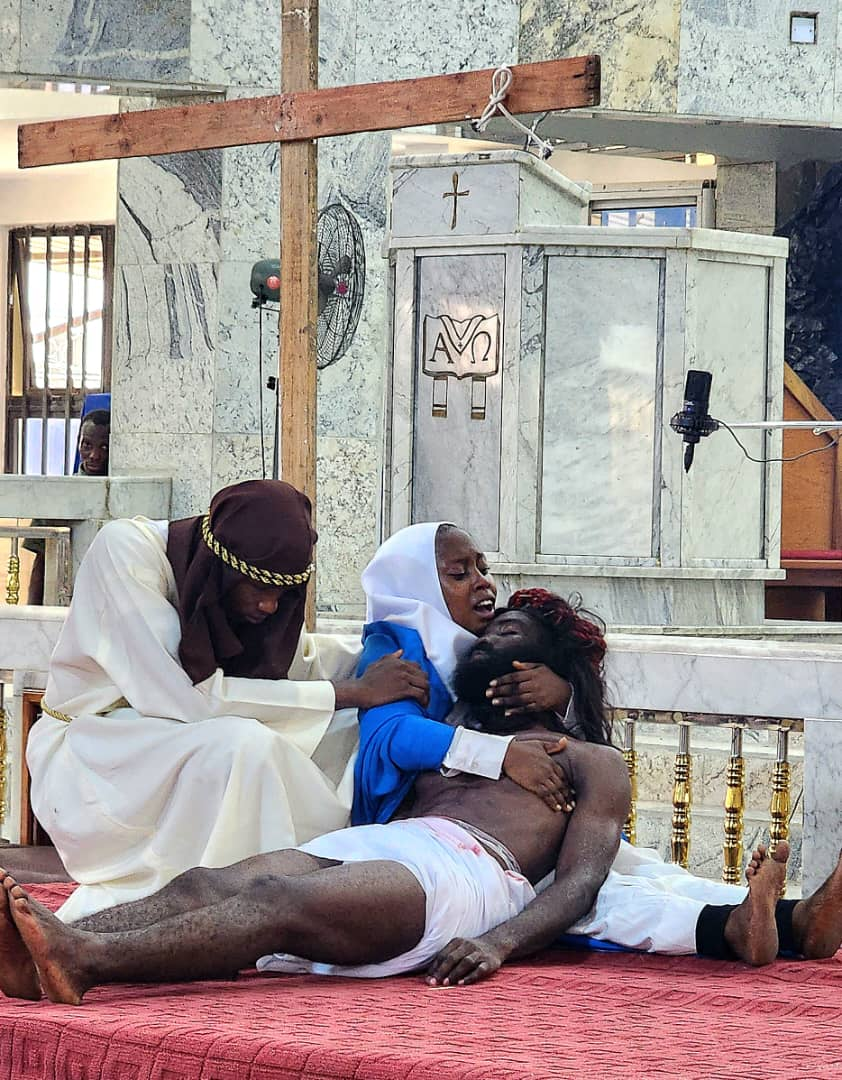
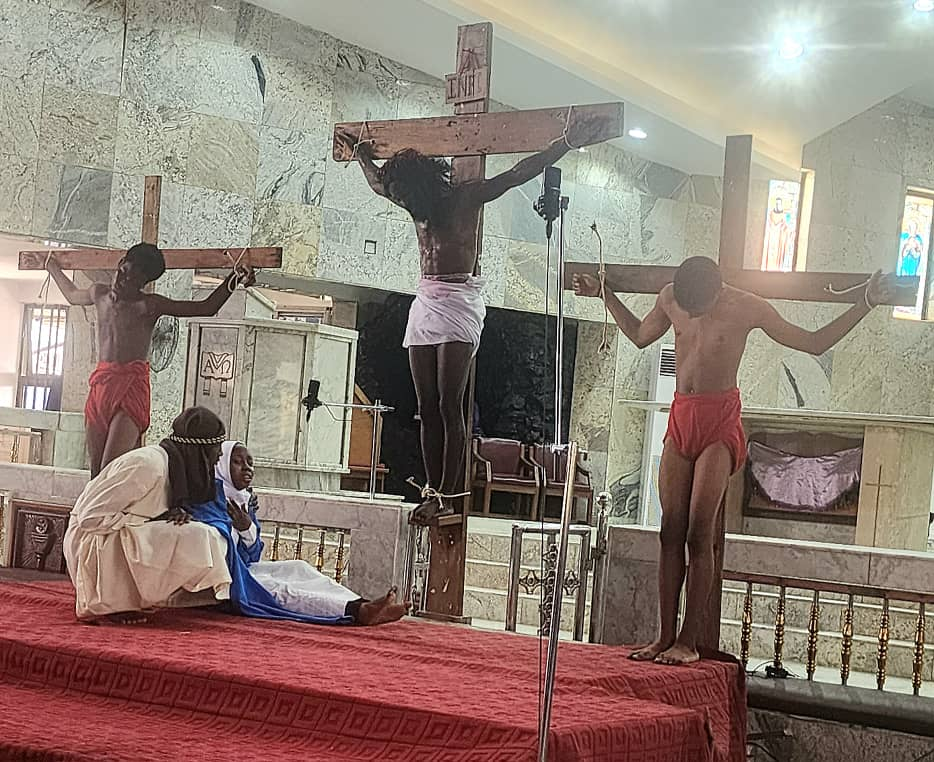
Neta and I observed our Good Friday at St. Mary’s Catholic Church, Isolo, my home parish from bachelor days. The day’s event unfolded with deep emotional and spiritual impact. It marks the Passion and crucifixion of Jesus Christ, a remembrance of His ultimate sacrifice for the redemption of humanity. It is a day of mourning, reflection and profound gratitude.
The liturgy began with a moving dramatization of the Lord’s Passion, interwoven with the Stations of the Cross, bringing vividly to life the journey to Calvary. This was followed by a brief but deeply solemn Mass, culminating in the presentation and veneration of the Cross, the very instrument upon which Christ laid down His life. Indeed, Good Friday stands as the most solemn day of the Triduum, heavy with the weight of sacrifice and love.
Holy Saturday then emerges as a day of quiet expectation, a sacred pause between death and resurrection. It signifies the time Christ lay in the tomb, a moment of silence, hope and anticipation. For Christians, it is a powerful reminder that even in the darkest hours, God’s plan is unfolding. The evening Easter Vigil breaks this silence with the lighting of the Paschal candle, symbolizing Christ as the Light of the World, conquering darkness and death.
This journey reaches its glorious climax on Easter Sunday, the celebration of the Resurrection of Jesus Christ. It is the cornerstone of the Christian faith, the triumph of life over death, hope over despair, and light over darkness. The Resurrection assures believers of new life and the promise of eternal salvation, reaffirming that suffering is never the end of our story.
In the final analysis, the Easter Triduum is not merely a sequence of liturgical events; it is a deeply transformative spiritual journey. From the humility of the Upper Room, through the pain of Calvary, to the silence of the tomb and the joy of the Resurrection, it calls every Christian to reflect, renew and rejoice. It is the very heartbeat of the Christian faith, a timeless reminder that after every Good Friday, there is always an Easter Sunday.
*Sir Paul Nwosu PhD is a 4th Degree Knight of the Catholic Order of St Mulumba.