By Polycarp Onwubiko

The various dimensions of the five-year ferocious “war” against the Monday sit-at-home, which officially ended on February 2, 2026, reveal the depth of resolve and leadership of the Anambra State Governor, Prof. Chukwuma Soludo.
The prolonged disruption, triggered by non-state actors, had held the state’s economy hostage and severely strained commercial activities. Confronting the challenge required both strategic thinking and bold action. Governor Soludo deployed substantial financial resources to mobilize the full spectrum of security agencies across the state.
There was palpable tension in Onitsha when the Governor, alongside members of the State Executive Council (EXCO), stormed the Onitsha Main Market after issuing a firm directive that public servants must resume work or face salary deductions, and traders must reopen their shops as security had been guaranteed.
The directive was substantially complied with, particularly by public servants. The Governor’s bold speech, reinforced with concrete assurances of effective security, restored confidence. The following Monday, traders, public servants, and school authorities resumed normal activities in significant numbers.
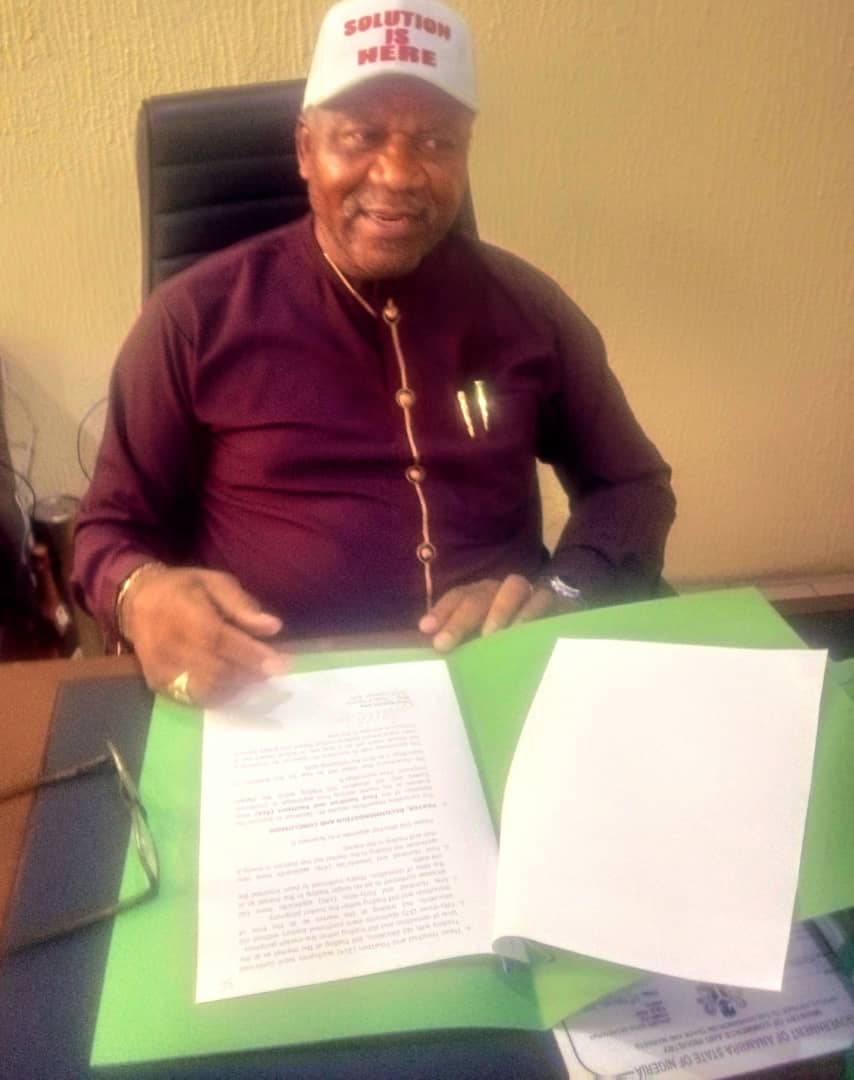
In this interview, the Special Adviser on Trade and Market, Chief Evaristus Uba, provides insight into the strategies that culminated in ending the Monday sit-at-home in Anambra State.
Interview
Q. Markets in the state are under your supervision. How did you feel when IPOB declared the Monday sit-at-home across the South-East in sympathy with the prosecution of Mazi Nnamdi Kanu five years ago?
A. Well, it was five years ago that IPOB declared the Monday sit-at-home. When Mr. Governor assumed office, he sought dialogue and even engaged Mazi Nnamdi Kanu in detention, who denied directing the enforcement of the sit-at-home order.
Subsequently, it emerged that a splinter group led by Simon Ekpa was responsible for enforcing it. Although their enforcement weakened over time, fear had already gripped traders and other groups in the South-East. Many chose to stay home for safety reasons.
Ironically, while people stayed home from business activities, they still engaged in social activities such as football, meetings, and other gatherings.
By 2025, traders began to observe that security in Anambra had significantly improved. December 2025 witnessed massive commercial activity without any major security incident. That gave us the confidence to act decisively.
The government insisted that public servants must report to work or face salary deductions, while traders were directed to reopen their shops. We also engaged transporters, who agreed to provide vehicles on Mondays, addressing complaints about high transportation costs.
Q. What were the consequences of the sit-at-home order? Can you quantify the losses?
A. If you calculate four Mondays per month over 12 months, that equals 48 Mondays annually. Over five years, that translates to almost an entire year of lost productive days.
Monetarily, Anambra State was losing approximately ₦8 billion every Monday in economic activities. The cumulative loss ran into billions annually when factoring in Internally Generated Revenue (IGR), trade volume, and the impact on low-income earners who depend on daily income.
It was a monumental economic setback.
It is also worth noting that Mr. Governor visited Mazi Nnamdi Kanu when he was granted bail and even appealed to federal authorities for his release, offering to take responsibility due to his constitutional immunity. However, that request was declined.
Q. What measures did the Governor adopt to end the sit-at-home? And how did traders overcome their fear of attacks?
A. Before enforcing compliance, Mr. Governor consistently reassured the public about improved security and worked diligently to strengthen it.
Critical stakeholders were engaged, including transport unions, traders’ associations, school authorities, banks, and business leaders. The objective was collective responsibility.
On February 2, 2026, when Onitsha Main Market reopened fully, there was visible deployment of the military, police, Navy, Nigeria Security and Civil Defence Corps, as well as local security outfits such as Agụnechemba and the Ocha Brigade.
Security operatives were strategically positioned throughout the market. Nothing untoward happened that day. The visible presence of security personnel dispelled the psychological fear that had previously gripped the populace.
Since that day, businesses have continued operating normally on Mondays without incident. It was indeed a masterstroke.
Q. How long will it take to recover the losses incurred during the sit-at-home period?
A. The losses are irrecoverable in literal terms. What is important now is that the bleeding has stopped.
Rather than dwelling on past losses, the focus is on economic recovery and growth. Government is encouraging businesses that relocated to neighboring states such as Delta to return, as security is now assured.
Onitsha Main Market remains a commercial powerhouse in Africa, and the business environment is now stable and secure.
Q. There are concerns that road expansion within the Main Market may affect traders. Will there be demolitions or compensation?
A. The government is not constructing a dual carriageway but expanding key roads such as Bright Street and Johnson Street, which traverse the Main Market.
Over time, illegal projections and encroachments extended beyond approved building lines, narrowing access roads. Some individuals built on drainage systems, fire hydrants, and open spaces designated for parking.
The government is simply reclaiming these illegal structures. Markets were originally designed with parking spaces, and as the Governor says, “If you can’t shop, you can’t park.”
Only unauthorized structures will be removed to restore accessibility and safety.
Q. What message do you have for traders from neighboring states who stopped coming to Onitsha?
A. Since February 2, 2026, Onitsha Main Market has been fully open for business. We assure all traders and customers outside the state that there is no cause for fear.
Anambra is safe for commerce once again.
Q. There are reports that non-state actors still disturb some markets in parts of Ihiala Local Government Area. What is being done?
Security operations are ongoing. The Governor receives daily security briefings and remains proactive.
About 62 illegal camps established by non-state actors have been dismantled across the state. However, security vigilance continues.
Border communities such as Isseke are being secured, and markets in those areas are now open and functioning.
Q. Any final message to Ndị Anambra?
A. Anambra is peaceful and remains a business-friendly state. Non-state actors no longer hold sway in our markets.
We urge traders, investors, and customers to return and resume their businesses confidently.
The state is open for business.