By Law Mefor
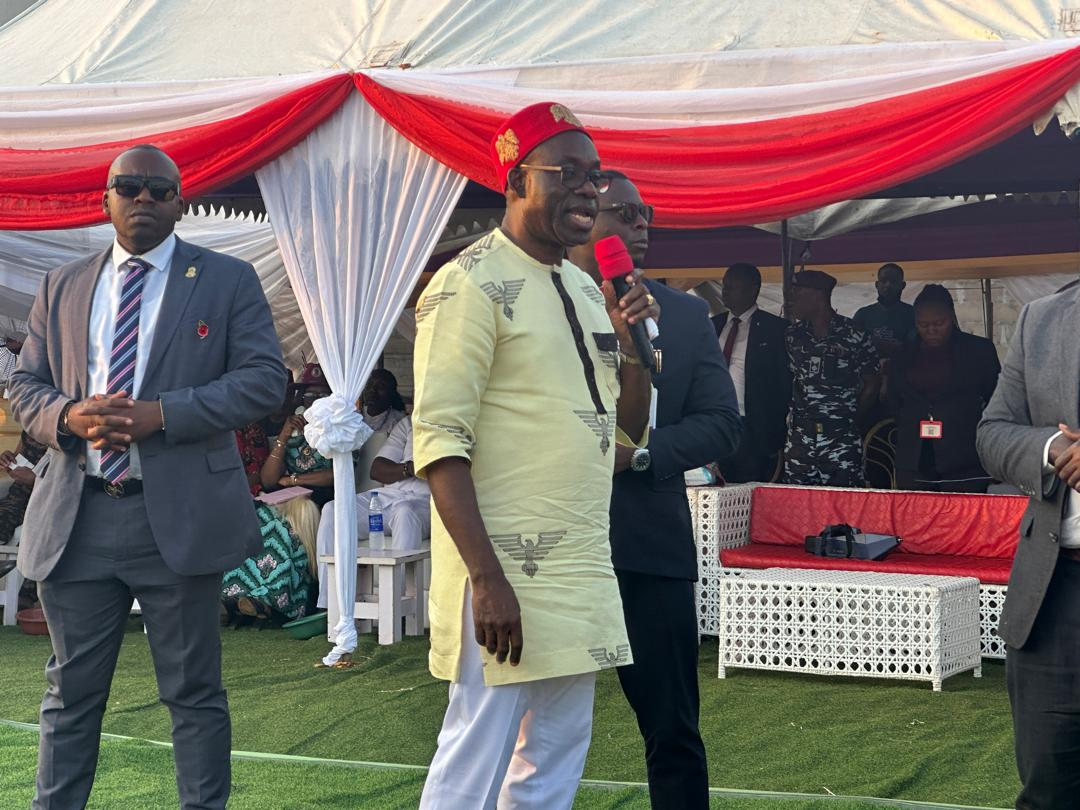
The Vice President of the Federal Republic of Nigeria, His Excellency Senator Kashim Shettima, GCON, returned to Anambra State a little over one week apart to commission the iconic Ekwulobia Flyover and associated projects completed by the Solution Governor, Prof. Chukwuma Charles Soludo, CFR.
It was a visit that deserves more than a passing mention in the news cycle. It deserves interpretation, because in Nigerian politics, timing is often as important as the event itself.
Vice President Shettima was first in Anambra on the 19th of November for the flag-off of the APC presidential campaign rally in the state. He could have commissioned the flyover on that same trip. It would have been convenient. It would have been cheaper. It would have been politically expedient. He chose not to.
He returned a week later, on the 27th of November, specifically to commission the Ekwulobia Flyover and other projects. That deliberate separation is the first significance of the visit.
There are strong reasons why the Vice President wanted it that way.
First, it was a mark of respect for Anambra and for Governor Soludo. By refusing to mix politics with governance, the Vice President made it clear that the commissioning was not a campaign stop. It was a state event, deserving its own dignity, its own audience, and its own attention. It was an acknowledgement that the Ekwulobia Flyover is not a party project. It is a people’s project.
In a country where projects are often commissioned as an afterthought at political rallies, this was a refreshing departure. It said: Anambra deserves better. Soludo’s work deserves to be seen on its own merit.
Second, the return visit was a recognition of performance. A Vice President does not fly back within seven days to commission a project unless that project matters. And the Ekwulobia Flyover matters, enormously.
Ekwulobia was once a symbol of chaos. Anyone who has travelled through Ekwulobia in the past knows the story: endless traffic gridlock, traders spilling onto the road, unplanned growth, commercial disorder, and urban decay. It was a town bursting at the seams, a strategic junction linking Aguata, Orumba, Nnewi, and beyond, but choked by its own importance.
Today, that story has changed. The Ekwulobia transportation hub, anchored by the flyover, is a signature statement of urban regeneration. It is Soludo’s penchant made concrete: the ability to take an urban slum and turn it into a haven.
We saw it in Okpoko. For decades, Okpoko was spoken of as a forgotten place, a slum that no government wanted to touch. Soludo went there, cleaned it up, gave it roads, gave it water, gave it dignity. He did not just build infrastructure; he restored pride. What he did in Okpoko, he is now repeating in Ekwulobia, in Awka, in Onitsha, and across the state.
Governor Soludo has over 200 other projects awaiting commissioning. That figure alone tells a story. It tells a story of a government that is not just awarding contracts, but completing them. It tells a story of a governor who believes that a project is only a project when it is delivered to the people. Ekwulobia is therefore not an isolated achievement. It is one chapter in a much larger book of transformation.
Third, the visit was a bridge between Anambra and the centre. The Vice President used the occasion to announce new projects President Bola Ahmed Tinubu has approved for Anambra and the South East, including the Aguleri-Otuocha road and the Oba-Nnewi-Okigwe dual carriageway.
These are not token gestures. They are strategic investments. The Aguleri-Otuocha axis opens up Anambra’s agricultural belt, connects riverine communities, and strengthens food security. The Oba-Nnewi-Okigwe dual carriageway eases movement between Anambra, Imo, and Abia, deepens economic integration, and supports Nnewi, one of Nigeria’s greatest industrial hubs.
For a region that has long complained of federal marginalisation, these announcements matter. They show that engagement can produce results. They show that when a state government performs, the federal government listens.
Finally, and perhaps most importantly, the Vice President admonished that the South East cannot afford to play from the sidelines. He urged the zone to stay with the centre and enjoy the benefits befitting a major ethnic group in the Nigerian federation.
It was a frank, fatherly counsel. It was not delivered as a threat, but as an invitation. His message was simple: development follows engagement. No region develops by staying outside the room where decisions are made. The South East, with its population, its enterprise, its intellect, and its industry, must be at the table.
That message resonated because it was delivered not at a rally, but at a project site. It was backed not by promises, but by proof. The people of Ekwulobia could see the flyover. They could see the roads. They could see the bus terminal. They could see a government working.
Governor Soludo understood the moment. He received the Vice President not as a partisan visitor, but as a partner in development. That is the essence of Soludo’s politics: Anambra first, development above partisanship, and results above rhetoric.
Soludo has consistently argued that Anambra must work with the centre, regardless of party differences, to attract federal presence and investment. The Shettima visit vindicated that philosophy. It proved that performance is a language every government understands.
The significance of Shettima’s visit, therefore, goes beyond the commissioning of a flyover. It signals a new era of federal-state cooperation for Anambra. It signals that performance is being noticed at the highest level. And it signals that Anambra, under Soludo, is no longer on the margins of national development discourse, but at its centre.
Ekwulobia is now a landmark. But more than that, it is a metaphor. A town once defined by gridlock is now defined by flow. A state once defined by abandoned projects is now defined by completed ones. A people once defined by lamentation are now beginning to define themselves by transformation.
With over 200 projects awaiting commissioning, Anambra is only just beginning. If Ekwulobia is what one week can produce, imagine what the coming months will unveil.
The Vice President came, he saw, and he acclaimed. That acclamation is the real commissioning.
*Dr Law Mefor is Anambra State’s Commissioner for Information and Value Reformation.