The Anambra Creed: The Legacy We Must Sustain
By Paul Nwosu PhD || AlphaTimes
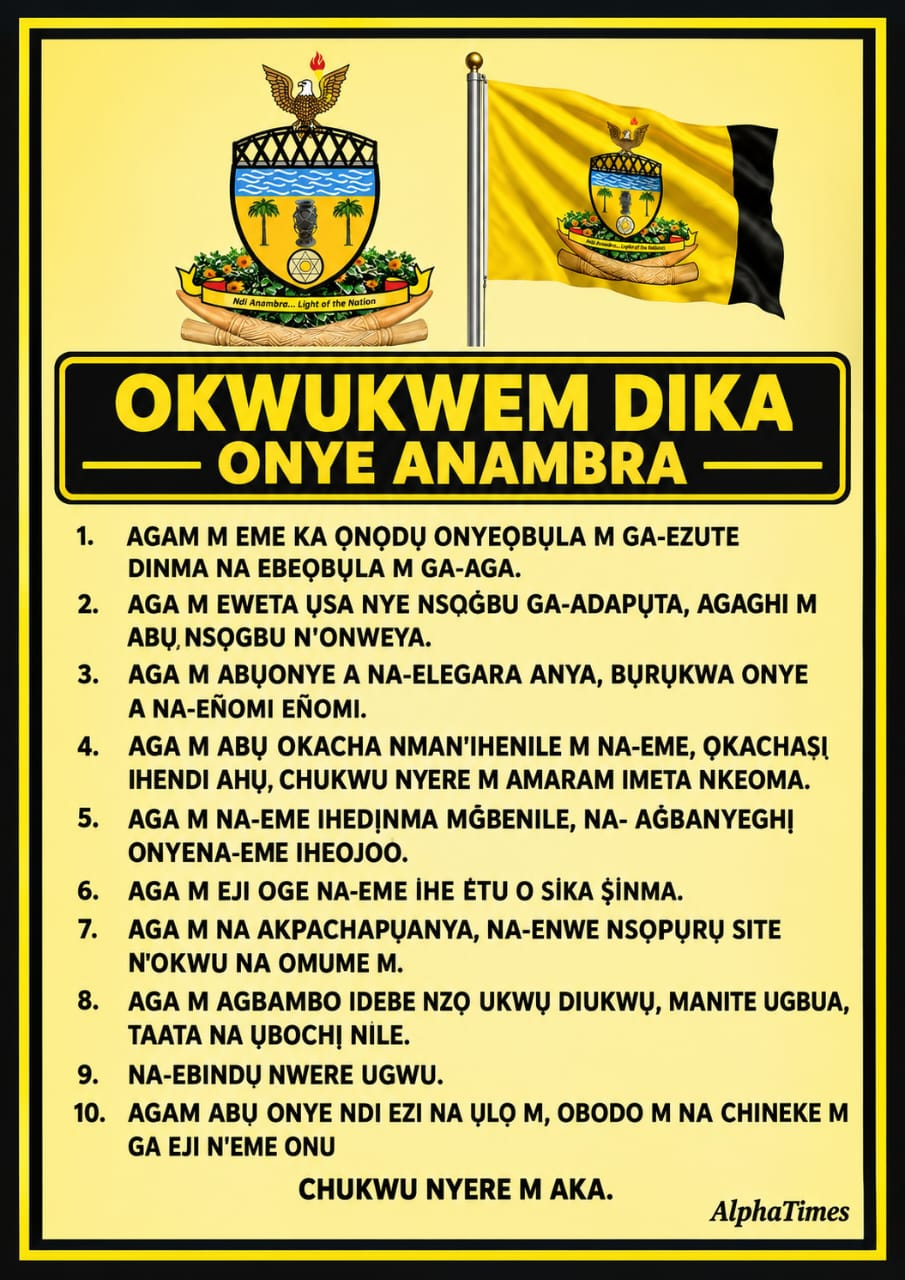
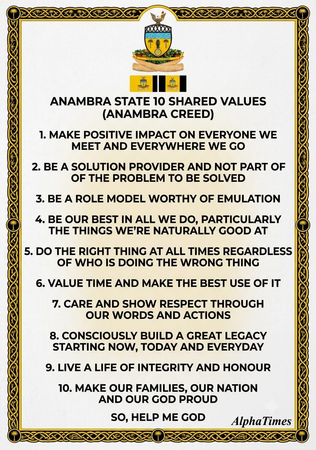
If the first five of the Ten Shared Values challenge Ndi Anambra to make a positive impact, provide solutions, become role models, pursue excellence and stand for what is right, the remaining five take the conversation into another important territory. And that is how we use our time, how we treat others, what we leave behind and who we ultimately seek to make proud.
- Value time and make the best use of it
Time is one resource that cannot be recovered once lost.
For a people whose history is deeply associated with enterprise, this value is a reminder that opportunity and productivity are inseparable from the disciplined use of time.
It calls for punctuality, seriousness, productivity and an appreciation that every wasted hour represents an opportunity that may never return.
A society that values time will naturally value productivity.
- Care and show respect through our words and actions
Real respect is not superficial. It is intrinsic; it is attitudinal. It should be positively earned. It should be given without coercion. It is not something we demand from others. It is something we voluntarily demonstrate because it is the right thing to do.
This value asks Ndi Anambra to show care and respect not only through what they say, but through what they do.
How we speak to one another, how we treat the vulnerable, how we conduct business, how we disagree and how we exercise authority all reveal the quality of our character.
A successful society cannot be built on enterprise alone. It must also be built on human dignity and mutual respect.
- Consciously build a great legacy starting now, today and everyday
Legacy is often associated with old age, retirement or the end of a career. But this value presents a different philosophy because legacy begins today.
Every decision contributes something to the story we eventually leave behind.
The question is therefore not simply what we achieve, but what remains because we lived.
For an Onye Anambra, building a great legacy means consciously creating value, helping others, raising responsible children, building institutions, serving communities and contributing something worthwhile to society.
Tomorrow’s legacy is being written by today’s choices.
- Live a life of integrity and honour
This is perhaps the moral anchor of the entire Creed.
Integrity means doing what is right even when there is no applause, reward or supervision. Honour means living in a manner that allows one’s name to command respect.
Material success without integrity can become a hollow achievement.
This value therefore reminds Ndi Anambra that what we become is ultimately more important than what we acquire.
A society that produces wealth without character may become prosperous, but it cannot become truly great.
- Make our families, our nation and our God proud
The final value brings the entire journey full circle.
It begins with the individual but ends with something larger than the individual – our family, our nation and our God.
It reminds every Onye Anambra that our actions have consequences beyond ourselves. We carry our families’ names. We contribute to the character of our nation. And for those who believe in God, we ultimately remain accountable to Him.
Then comes the simple but profound conclusion: “So, help me God.”
It is not merely a closing sentence. It is an acknowledgement that building character, sustaining integrity and living out these ideals require both personal commitment and divine assistance.
This is why the Ten Shared Values deserve to survive beyond the administration that conceived them.
Their value should not be measured by the political identity of the government that introduced them, but by the kind of society they can help produce.
Governments come and go. Political parties rise and fall. Administrations change. But a people’s values should have a longer lifespan than any government, administration or political party.
If every incoming administration discards the civic values of its predecessor and introduces a new set merely to establish its own identity, the greatest casualty is the people.
Cultural transformation does not happen overnight. It happens through repetition that cannot afford to be broken every four or eight years as the case may be.
It happens when children hear the same principles at home and in school. It happens when leaders practise what they preach. It happens when public institutions reinforce the same standards. It happens when communities celebrate those who live by them and question those who violate them.
Over time, the values move from words to habits, from habits to character, and from character to culture. That is when the real reformation and transformation begins.
Imagine a generation of Ndi Anambra for whom making a positive impact is normal; solving problems is expected; excellence is pursued; integrity is respected; time is valued; others are treated with dignity; legacy is consciously built; and family, nation and God remain important measures of success.
Such a society would not need to constantly announce its identity. It would demonstrate it.
That, ultimately, is what Brand Anambra should be about. A brand becomes truly powerful when it becomes a people’s way of thinking, behaving and living.
The Ten Shared Values provided a foundation for that journey. They should therefore be taught, sustained, practised and progressively internalised, not because they belong to any former governor or administration, but because they belong to an idea of the Onye Anambra we should aspire to become.
The political administration that created them may have changed. Others will come and go too. But the work of building and reforming the character of our people must continue.
Governments can build roads, bridges, schools, hospitals, etc. But only a people of character can build a great society.
And if Brand Anambra is ultimately about building a great society, then perhaps the most important question is no longer what does Anambra’s brand look like? It is: What does an Onye Anambra look like?The answer should be found, not merely in the symbols we display, but in the values we live.
So, help us God.
( The end. To read the entire 6-Part Series, visit: www.alphatimes.ng)