By Paul Nwosu PhD || AlphaTimes
One of the clearest indicators of an organised society is the discipline with which its citizens use their roads. The respect motorists show for traffic rules and regulations reflects not only the level of order in that society but also its regard for human life, public safety and the rule of law.
Beyond ensuring the smooth flow of traffic, road discipline has far-reaching implications for the safety of motorists, passengers, pedestrians and other road users. It is for this reason that the Federal Road Safety Corps (FRSC), in one of its public enlightenment campaigns, aptly stated: “Obeying traffic rules is not just about following the law; it is about valuing your life and the lives of others.”
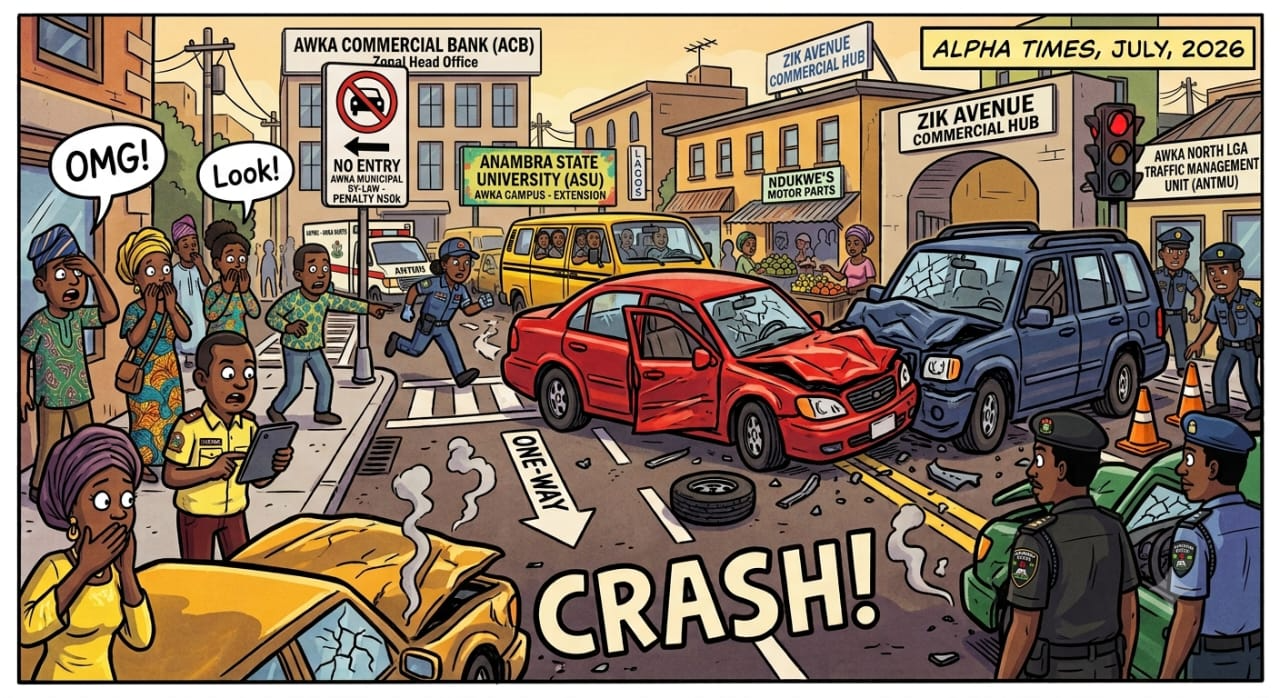
Against this backdrop, many of us welcome the Anambra State Government’s decision to approach the State House of Assembly to strengthen the state’s traffic laws by prescribing stiffer sanctions for dangerous driving. The proposed amendments target specific offences such as driving against oncoming traffic and using the wrong side of dual carriageways to avoid making proper U-turns. According to the government, offenders may not only face substantial fines but could also be subjected to psychiatric evaluation.
This is undoubtedly a step in the right direction. The lawlessness and impunity that have come to characterise our roads, especially in our bustling commercial centres and densely populated urban areas, have reached intolerable levels. Reckless driving now endangers not only motorists and passengers but also innocent pedestrians using sidewalks or attempting to cross the road. Beyond the tragic loss of lives, these acts result in avoidable injuries, destruction of property and needless economic losses.
The House of Assembly should seize this opportunity to further strengthen existing traffic laws relating to speed limits, compliance with traffic lights and road signs, driving under the influence of alcohol or drugs, zebra crossings, compulsory spare tyres, warning triangles, fire extinguishers and other essential safety requirements.
There is also a compelling case for a comprehensive legal framework governing the operation of tricycles, which have become a dominant means of transportation across the state. Although many of these provisions already exist under federal traffic laws, domesticating and adapting them to Anambra’s peculiar realities would strengthen enforcement. As the gateway to the South-East, Anambra receives an enormous volume of light and heavy-duty vehicular traffic daily, making stricter state-specific regulations both necessary and justifiable.
But, legislation without consistent enforcement is little more than ink on paper. For these reforms to achieve their intended objectives, the Anambra Traffic Management Agency (ATMA) must be strengthened. Its personnel should receive continuous professional training, be adequately motivated, equipped with modern enforcement tools and, where necessary, supported by the armed Police or the Nigeria Security and Civil Defence Corps. Sustained enforcement, backed by visible sanctions, will gradually compel road users to internalise a new culture of discipline.
However, this can only succeed if there are no sacred cows. ATMA must be empowered to enforce the law impartially, regardless of the offender’s status or affiliation. While commercial drivers are often blamed for traffic offences because of their relentless pursuit of daily earnings, some of the worst offenders are drivers of government vehicles, security agencies not engaged in emergency duties, refuse collection trucks and contractors’ vehicles. When these categories of offenders are arrested and sanctioned like every other citizen, the public will receive a clear message that the government is genuinely committed to restoring sanity on our roads.
At the same time, the law should clearly define exemptions for emergency and essential service vehicles such as ambulances, fire service trucks and other officially designated emergency responders whose operations may legitimately require limited waivers under strictly regulated circumstances.
Equally important is sustained public enlightenment. Citizens deserve adequate notice that the era of traffic impunity is coming to an end. They must understand not only the new rules but also the reasons behind them. Compliance grows faster when people appreciate that traffic laws exist not to punish but to protect.
Governor Charles Chukwuma Soludo’s Dubai-Taiwan (DT) vision is not merely about constructing world-class infrastructure. It is equally about building a society whose citizens demonstrate discipline, responsibility and respect for public assets. Roads are only as efficient as the people who use them.
Ultimately, the Dubai-Taiwan dream must be a genuine partnership between government and the governed. Government can build the roads and enact the laws, but citizens must embrace the culture of obedience and civic responsibility. Without that shared commitment, both parties will continue pulling in opposite directions, turning what should be progress into the familiar cycle of one step forward and two steps backward.
If Anambra truly desires lasting societal reformation, then restoring discipline on our roads would be an excellent place to begin.