By Paul Nwosu PhD || AlphaTimes
————-‐————————-
Let me confess that I actually wrote this piece and produced the accompanying video documentary some months ago, then tucked both away in my laptop. I had almost forgotten about them until I recently saw Prof. Solo Chukwulobelu, now Chief Policy Adviser to the Managing Director of the South-East Development Commission (SEDC), in the news alongside Managing Director Mark Okoye and his team during their inspection of the site of the Commission’s first agro-mechanisation project at Nomeh Unateze in Enugu State.

That encounter jolted my memory. Suddenly, the forgotten piece and video documentary came alive again. I felt it was time to bring them out of the archives, and let them speak to the moment.
During my time serving in the government of Anambra State, I often heard the immediate past Secretary to the State Government of Anambra State (and presently the Chief Policy Adviser to the Managing Director, South-East Development Commission), Professor Solo Osita Chukwulobelu, speak with unmistakable pride about Chukwulobelu Farm in Ugwuoba, an agricultural estate inherited from his late father, a renowned textile merchant whose entrepreneurial vision extended into farming.
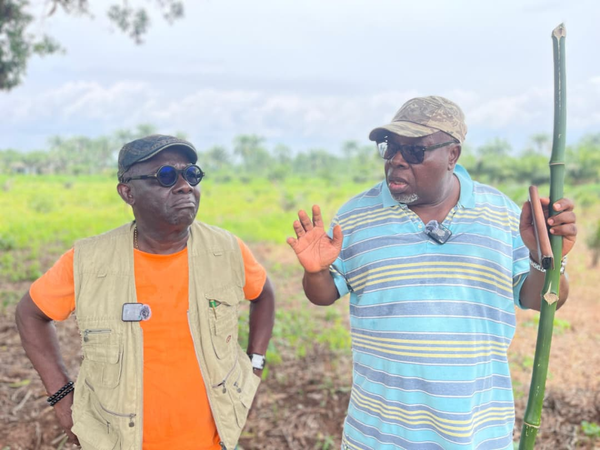
Those reflections always carried a tone of conviction and purpose that got me interested. So, sometime in May, after Mass at Sacred Heart Chaplaincy Parish, Ngozika Estate, Awka, where we both worship, our usual banter drifted naturally toward his current preoccupation which is agriculture.
As an indigene of Ogbaru, where farming and fishing remain defining occupations and cultural anchors, my curiosity was immediately stirred. I wanted to see firsthand what had captured the attention and energy of a man who had taught corporate finance in universities in Nigeria and United Kingdom, and occupied one of the highest administrative offices in the state. More importantly, I wondered whether his experience might inspire others to embrace agriculture as both enterprise and contribution to food security. So, we agreed on a date to visit his farm.
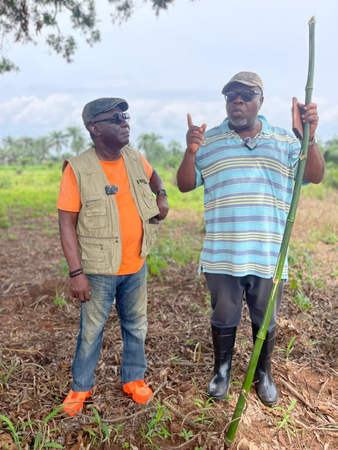
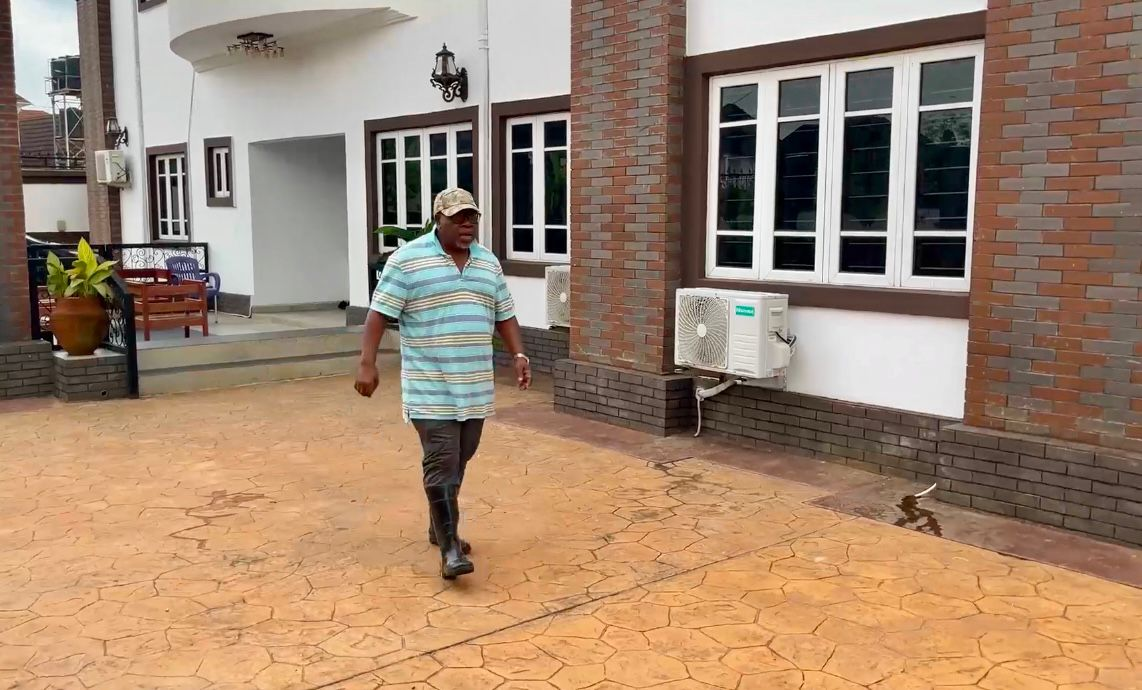
Upon arrival, the farm’s modest entrance gate and ageing farmhouse gave little indication of what lay beyond. First impression, in this case, proved remarkably deceptive.
Our tour began with the produce-processing facilities, a palm milling plant, a garri processing factory currently operated through an outsourced arrangement, and storage units containing freshly processed palm oil. These installations reflected an integrated approach to agriculture – cultivation linked directly to value addition.
But it was what stood behind those structures that truly transformed the experience.
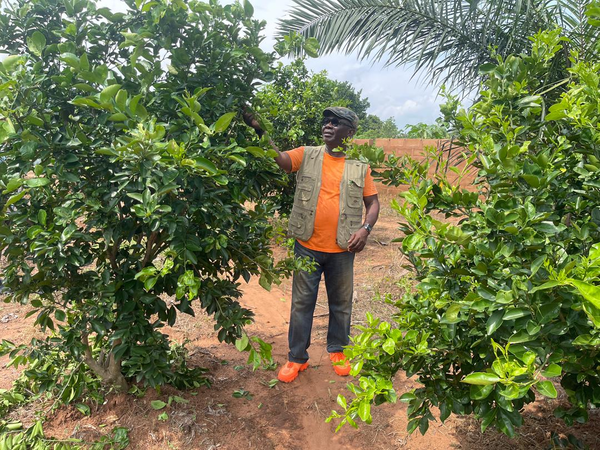
Stretching across roughly 20 hectares was a vast landscape of greenery, a living mosaic of commercial agriculture.
Professor Chukwulobelu explained that, historically, the farm had cultivated staple crops including yam, cassava and maize alongside extensive palm plantations. However, with more time now available to devote to agricultural enterprise, he had chosen to recalibrate the farm’s strategic direction, gradually shifting emphasis from subsistence and food crops toward higher-value commercial cultivation. His vision is ambitious and methodical.
The entire estate is being redesigned into clearly demarcated agricultural zones, allowing each crop category to occupy dedicated sections for improved management, productivity and long-term scalability.
The farm itself carries historical significance. Established in the 1960s during the era of Dr. M. I. Okpara’s celebrated agricultural revolution in the old Eastern Region, a period that sought to position the region as a model of agrarian excellence, the estate once boasted over 1,000 palm trees.
Even today, many of those ageing palms remain productive, standing as enduring symbols of long-term investment and the wisdom of generational planning.
Looking ahead, Professor Chukwulobelu intends to expand and modernise cultivation through scientific orchard management. New palm and coconut plantations are being established in carefully spaced columns based on recommendations from a professional agronomist engaged to support the restructuring.
Other crops, including oranges, plantains, kolanuts, bitter kola, soursop, breadfruit, mangoes, and pawpaw, will be cultivated in dedicated orchard clusters to optimise yield, ease of maintenance and future mechanisation.
He admits that this transition phase has not been easy. Breaking even during a period of reinvestment and restructuring remains challenging. Yet his optimism is unmistakable. He believes that within the next two to three years, once the new seedlings mature beyond their formative stages, the farm will begin generating sufficient returns to offset operating costs, support expansion across other Chukwulobelu agricultural holdings, and create sustainable profitability.
His long-term aspiration is bold. And that is to build Chukwulobelu Farms into a commercially viable agribusiness with the capacity, one day, to be listed on the Stock Exchange.
For now, Professor Chukwulobelu appears to be treating this interval in public service not as retirement, but as reinvention. Judging from his looks, the man appears physically strong and mentally alert to still offer his expertise and experience in any sphere of public service in this country.
Standing amid rows of palms and newly mapped orchards, one gets the impression that this is about more than farming. It is about continuity, stewardship, and transforming inherited assets into future opportunities.
In an era where conversations about economic diversification often remain theoretical, Chukwulobelu Farm offers something more tangible. A reminder that agriculture still possesses the power to create wealth, preserve legacy and shape the future.